
Views: 270 Author: Otechkabel Publish Time: 2026-09-26 Origin: Site


Content Menu
● Introduction: Sourcing 8K HDMI Cables for African Markets
● How Suppliers Were Evaluated
>> Manufacturing and Product Capability
>> Communication and Delivery Stability
● Leading 8K HDMI Cable Suppliers and Supply Options
>> 1. Shenzhen Otechkabel Electronic Co., Ltd.
>> 2. Cablink
>> 3. Cabletime
>> 5. South African AV Distributors
>> 6. Kenya IT and Electronics Wholesalers
>> 7. Nigeria Electronics Importers and Wholesalers
>> 8. North African Distributors and Assemblers
● Technical Requirements for 8K HDMI Cable Procurement
>> Bandwidth and Video Requirements
● Common Sourcing Risks and How to Avoid Them
>> Risk 1: "8K" Marking Without Real Performance Evidence
>> Risk 2: Same Appearance, Different Internal Materials
>> Risk 3: Incorrect Certification Claims
>> Risk 4: Low MOQ With Hidden Limitations
>> Risk 5: Long-Length Cable Failure
● Practical Procurement Process
>> Step 1: Create a Detailed RFQ
>> Step 2: Compare Samples, Not Only Prices
>> Step 3: Confirm Quality Before Mass Production
>> Step 4: Calculate Total Landed Cost
>> Step 5: Use a Long-Term Supply Approach
● FAQ
>> 1. Is every 8K HDMI cable a real 48Gbps cable?
>> 2. How can I confirm whether a supplier's ISO certificate is valid?
>> 3. Can a 10-meter HDMI cable support 8K@60Hz?
>> 4. Are CE and RoHS documents enough to prove HDMI performance?
>> 5. What is the safest way to start a private-label 8K HDMI cable project?
For professional buyers in Africa, sourcing an 8K HDMI cable involves more than finding a supplier that can print "8K" or "48Gbps" on retail packaging. The real challenge is identifying a supply partner that can provide stable product quality, consistent materials, credible test documentation, dependable production lead times, and flexible private-label support.
Demand for 8K HDMI cables is growing across African consumer-electronics and professional AV markets. Gaming consoles, high-refresh-rate monitors, premium televisions, home theater systems, video conferencing equipment, commercial displays, education projects, and digital-signage installations are all increasing the need for higher-bandwidth HDMI connectivity.
In most African markets, specialized HDMI cable manufacturing remains limited compared with Asia's established electronics supply chains. Countries such as South Africa, Egypt, Morocco, Kenya, and Nigeria have important electronics distribution, assembly, retail, logistics, and AV-installation sectors. However, many regional brands, wholesalers, and project contractors still source HDMI cable products from OEM factories in China and other Asian manufacturing hubs.
This makes supplier selection especially important. A buyer may work with:
- A specialist cable manufacturer for OEM production
- A regional distributor for local warehousing and replenishment
- An AV integrator for project-based supply
- A local importer for market access and retail distribution
- A mixed supply model combining direct factory purchasing with regional logistics support
The ideal choice depends on order volume, required customization, target market, shipping strategy, compliance requirements, and the technical level of the HDMI cable product.
A professional cable supplier should be assessed through practical and verifiable criteria rather than broad marketing claims. The companies and supply models in this guide are reviewed according to their relevance for professional buyers looking for 8K HDMI cable sourcing, private-label development, and stable supply support.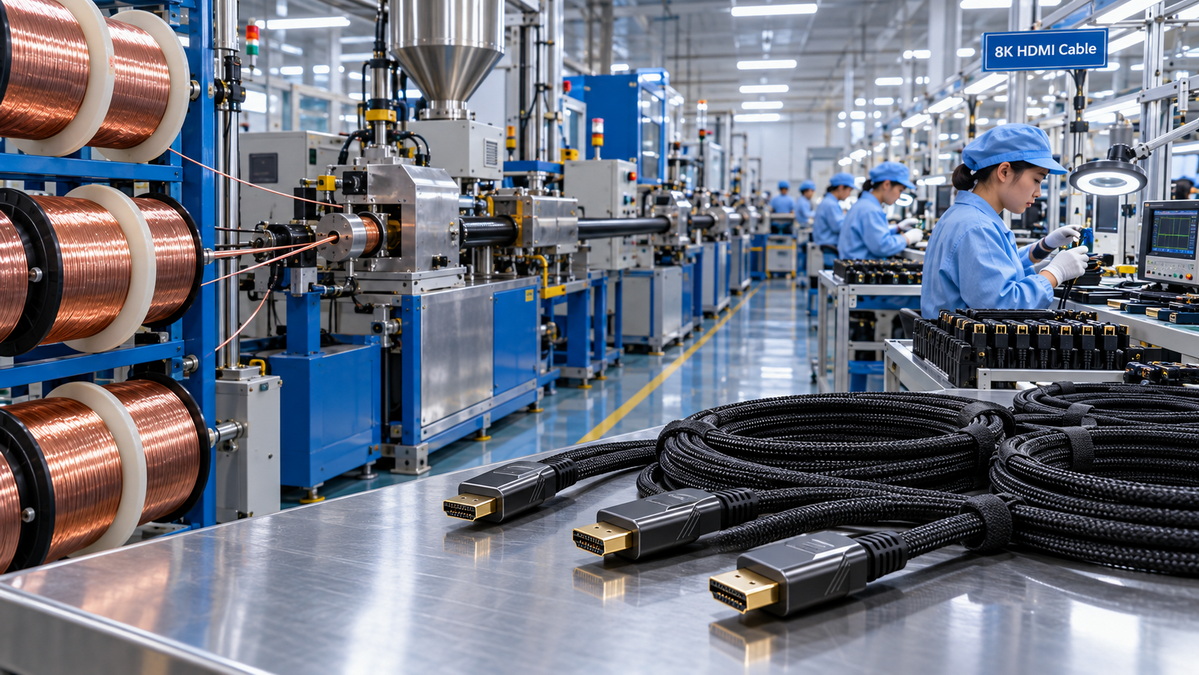
A capable supplier should be able to explain what type of HDMI cable it produces and how the product is constructed. This includes the difference between passive copper cables, active copper cables, and active optical HDMI cables.
For 8K HDMI cable projects, buyers should ask suppliers about:
- Maximum supported bandwidth
- Supported video formats
- Cable length limitations
- Conductor material and gauge
- Shielding structure
- Insulation material
- Connector construction
- Molding quality
- Strain-relief design
- Outer-jacket material
- Active chipset specification for active cable designs
- Test procedure for each cable length
A supplier that cannot explain these points clearly may be selling a generic product without sufficient engineering control.
For private-label buyers, OEM service should involve more than printing a logo on an existing cable. Useful customization options may include:
- Custom cable lengths
- PVC, TPE, braided nylon, or low-smoke jacket options
- Connector shell colors and finishes
- Custom overmolding design
- Branded connector housing
- Retail box design
- Polybag, blister pack, or hang-tag packaging
- Barcode and carton marking support
- Country-specific language labeling
- Product bundles with adapters, hubs, splitters, and switches
- Custom molding and tooling development
Buyers should confirm whether the supplier has internal product-development capability or relies entirely on third-party component suppliers.
A reliable 8K HDMI cable supplier should have a documented quality-control process covering materials, production, testing, and final shipment.
Important quality-control checkpoints include:
- Incoming inspection for copper conductors, insulation, connector shells, and packaging materials
- In-process checks during soldering and connector assembly
- Inspection during overmolding and strain-relief production
- Continuity testing
- Signal-performance testing
- Mechanical durability testing
- Packaging inspection
- Carton drop testing where required
- Final random inspection before shipment
- Batch traceability and shipment records
The objective is not only to ensure that a cable works once in a sample test. The objective is to ensure that the same quality is repeated across every carton and every future production batch.
Compliance requirements vary by destination market. Buyers should request documentation that matches the specific cable model and the actual market where the product will be sold.
Common requests include:
- CE-related documentation where applicable
- RoHS declaration
- REACH declaration
- PAHs declaration
- Material safety information
- Product test reports
- Packaging-material declarations
- Product traceability information
- Factory audit reports where available
- Certification details for officially certified cable models
A generic certificate image is not enough. The supplier should be able to explain whether the report applies to the exact model, cable length, material construction, and production location.
For African importers, logistics planning can strongly affect the final landed cost of HDMI cables. A supplier should provide realistic information about production timing, carton quantity, shipment planning, and export documentation.
Key commercial points include:
- Sample lead time
- Mass-production lead time
- Peak-season production capacity
- MOQ by cable type and packaging method
- Payment terms
- Export packing standard
- Mixed-SKU loading options
- Shipping-port options
- Incoterms
- Product labeling support
- Pre-shipment inspection arrangements
- Warranty and claim-handling process
Reliable communication is particularly important when buyers need revisions to cable length, packaging artwork, carton markings, or technical specifications.
| Supplier / Supply Option | Location and Role | Typical MOQ Position | Main Strength | Suitable Buyer Type |
|---|---|---|---|---|
| Shenzhen Otechkabel Electronic Co., Ltd. | Shenzhen, China OEM manufacturer | Flexible based on cable design and packaging | Custom OEM/ODM cable development and responsive support | Small and medium brands, distributors, importers |
| Cablink | China cable manufacturer | Confirm by product specification | Multi-category cable and interface product capability | Wholesalers and brands needing broad product ranges |
| Cabletime | China cable manufacturer and exporter | Confirm by SKU and customization level | HDMI cables, accessories, wholesale and branded programs | Retail distributors and online sellers |
| FYCables / Foyun | China OEM cable supplier | Often suitable for lower-MOQ programs | Private-label and custom packaging support | New brands and e-commerce sellers |
| South African AV distributors | South Africa regional distribution | Usually lower for stock items | Local inventory and faster delivery | AV installers and project buyers |
| Kenya IT and electronics wholesalers | East Africa distribution model | Usually stock-based | Regional fulfillment and mixed-SKU purchasing | East African retailers and resellers |
| Nigeria electronics importers | West Africa wholesale and distribution | Commonly carton-based | Retail and wholesale market coverage | Retail-channel brands and importers |
| North African distributors and assemblers | Egypt and Morocco regional supply model | Depends on project and stock availability | Local language and regional logistics support | North African distributors and AV projects |
Shenzhen Otechkabel Electronic Co., Ltd. is a China-based cable manufacturer focused on HDMI cables, USB cables, VGA cables, DVI cables, SATA cables, adapters, hubs, splitters, switches, and related cable accessories.
The company is particularly relevant for small and medium-sized international brands, wholesalers, e-commerce sellers, electronics importers, and project buyers that require more flexibility than highly standardized large-volume factories usually provide.
Shenzhen is one of China's most important electronics manufacturing centers. The city has an established supply chain for connectors, molded plastic parts, packaging, cable materials, testing equipment, electronic components, and export logistics. This environment helps cable manufacturers respond more quickly to product revisions, sample development, customized packaging, and multi-product purchasing requirements.
Shenzhen Otechkabel Electronic Co., Ltd. is positioned as a practical OEM partner for buyers seeking a balance between product customization, communication efficiency, manufacturing support, and cost control.
Its strengths include:
- OEM and ODM support for HDMI cable projects
- Flexible communication for small and medium private-label buyers
- Custom cable length, color, connector, and packaging options
- Support for HDMI cable bundles with adapters, hubs, splitters, and switches
- In-house research, product-development, and molding support
- Experience with multiple cable and accessory categories
- Ability to coordinate product samples, retail packaging, and export cartons
- Suitable for buyers launching or expanding a private-label HDMI cable range
For a branded 8K HDMI cable project, buyers can discuss requirements such as:
- 1 m, 1.5 m, 2 m, 3 m, 5 m, and longer cable lengths
- PVC-jacket or braided-jacket construction
- Different connector-shell finishes
- Custom logo printing
- Retail box design
- Private-label barcode labels
- Multilingual product information
- Export-carton marking
- Matching USB, adapter, hub, splitter, and switch products
The company is especially suitable for buyers who do not want to be treated as a generic catalog customer. Smaller brands often need help with packaging revisions, color matching, product positioning, technical explanations, and sample adjustments. A flexible factory relationship can reduce mistakes before mass production begins.
Buyers should still request model-specific cable specifications, test information, material details, packaging proofs, and production samples before confirming a purchase order.
Cablink is a cable manufacturer offering HDMI, USB, DisplayPort, Ethernet, charging, and related connectivity products. It is suitable for buyers who prefer to source several product categories from one supplier rather than purchasing HDMI cables alone.
The company promotes HDMI 2.1 and 8K cable options, including products positioned for high-bandwidth applications. It also offers OEM and ODM support for customers seeking customized cable products and packaging.
Cablink may be relevant for:
- Electronics wholesalers
- Consumer-accessory brands
- Computer-accessory distributors
- AV equipment resellers
- Retail chains
- Importers looking for HDMI, USB-C, and DisplayPort products together
Its product range can help buyers consolidate purchasing across several cable categories. This may simplify packaging coordination, container loading, and supplier management.
Buyers should verify the exact status of each 8K HDMI cable model, particularly when the product is intended for gaming, 4K@120Hz displays, 8K television systems, or advanced home-theater applications.
Important questions include:
- Is the quoted cable passive, active copper, or active optical?
- What cable lengths are available for the claimed bandwidth?
- Does each length use the same internal construction?
- What quality-control tests are performed before shipment?
- Can the supplier provide batch-level inspection information?
- What MOQ applies to custom retail packaging?
- Can the company support packaging in English, French, Arabic, Portuguese, or other market languages?
Cabletime is a cable and computer-accessory supplier offering HDMI cables, USB cables, adapters, hubs, docking stations, and related consumer-electronics accessories.
For buyers selling into retail, online marketplaces, computer stores, and consumer-electronics channels, Cabletime may be suitable because it offers a broader catalog of finished products.
The company's HDMI range includes HDMI 2.0 and HDMI 2.1 cable options positioned for higher-resolution displays and gaming applications.
Cabletime can be useful for buyers who need:
- Finished HDMI cable SKUs
- Branded cable accessories
- Mixed purchasing across several computer-accessory categories
- Retail-ready product packaging
- Wholesale supply for online and offline sales channels
- Product expansion beyond HDMI cables alone
The main advantage of a catalog-oriented supplier is that it can reduce product-development time for standard items. However, buyers should carefully distinguish between standard stock products and fully customized OEM products.
Before purchasing, ask for:
- Exact technical specification by cable length
- Material construction details
- Product dimensions and net weight
- Packaging dimensions and carton quantity
- Sample availability
- Compliance documentation
- Warranty terms
- Customization requirements and MOQ
- Delivery schedule for repeat orders
FYCables, also associated with the Foyun name, is an OEM-oriented cable supplier that promotes customized HDMI cable development and lower-MOQ options.
This type of supplier can be useful for emerging brands, e-commerce sellers, and distributors that want to test market demand before investing in a large cable program.
The company may be suitable for:
- New private-label HDMI cable brands
- Amazon and e-commerce sellers
- Retailers testing 8K HDMI cable demand
- Importers with limited first-order budgets
- Buyers needing customized packaging or logo printing
- Distributors building a small but focused cable range
A lower MOQ can reduce entry risk, but buyers should make sure that low MOQ does not result in lower-quality materials or insufficient testing.
Some suppliers may offer a low MOQ only for:
- Plain polybag packaging
- Existing cable lengths
- Existing connector designs
- Standard black cable colors
- Stock carton configurations
- Non-customized labels
Custom molds, special jacket materials, premium retail boxes, unique connector designs, and multilingual packaging may require higher order quantities.
The best approach is to separate the project into two stages:
1. A low-risk sample and market-testing order using standard construction.
2. A scaled private-label program after confirming sell-through and customer acceptance.
South Africa is one of Africa's leading markets for professional AV systems, consumer electronics, IT accessories, hospitality installations, education technology, and commercial-display projects.
For buyers who need quick domestic availability, warranty support, and smaller purchase quantities, South African AV distributors can be valuable supply partners.
These distributors may offer:
- HDMI cables for consumer and commercial use
- AV accessories
- Audio and video distribution products
- Mounting systems
- Signal extenders
- Switches and splitters
- Conference-room accessories
- Installation support
This model is especially useful for AV installers, system integrators, event companies, and corporate IT buyers.
However, distributors are usually not the original cable manufacturers. Their products may come from different upstream factories, and the product construction can vary between brands, batches, and price levels.
Buyers should request:
- Original manufacturer information
- Technical data sheet
- Warranty process
- Proof of product performance
- Stock availability
- Replacement policy
- Lead time for replenishment
- Product country of origin
- Information about long-length cable performance
For standard projects requiring short cable lengths and immediate local delivery, distributor sourcing can be highly efficient. For private-label retail programs or specialized cable requirements, direct OEM sourcing is usually more appropriate.
Kenya serves as an important business and logistics hub for East Africa. Local IT and electronics wholesalers can be useful partners for buyers supplying Kenya, Uganda, Tanzania, Rwanda, Ethiopia, and nearby regional markets.
These suppliers are especially helpful for buyers who need:
- Faster regional stock availability
- Smaller replenishment orders
- Mixed IT-accessory purchasing
- Local invoicing
- Regional distribution support
- Retail and reseller channel access
- Basic warranty handling
For stock-based purchasing, Kenya-based wholesalers can reduce the need to hold large imported inventory. They may also help buyers test local demand for HDMI cable products before making container-level factory orders.
However, buyers should ask detailed questions about the cable itself. The label "HDMI 2.1" or "8K" should not be accepted as proof of high-bandwidth performance.
Important checks include:
- Is the product designed for 48Gbps transmission?
- What is the maximum tested length?
- Is the cable passive or active?
- Does the supplier have product test reports?
- Is the product supplied with a consistent model number?
- Can the wholesaler guarantee future availability of the same model?
- What happens if a cable fails during a customer installation?
For retail and distribution businesses, it is often effective to combine local stocking with direct factory sourcing. High-volume, private-label items can come directly from an OEM factory, while small emergency replenishment orders can come from regional stock.
Nigeria has one of Africa's largest consumer markets and a strong demand base for mobile devices, televisions, gaming accessories, computer peripherals, home entertainment products, and consumer electronics.
Local importers and wholesalers can play an important role in bringing HDMI cable products to retail stores, online platforms, dealer networks, and regional distributors.
This supply model may be suitable for:
- Consumer-electronics brands entering Nigeria
- Retail distributors
- E-commerce businesses
- Computer-accessory wholesalers
- Gaming-accessory sellers
- TV and home-theater retailers
- Importers seeking local channel support
Nigeria-based supply partners may understand local retail pricing, consumer preferences, and distribution patterns. They can also help with warehousing, product replenishment, and sales-channel development.
However, buyers should avoid assuming that an importer is also a manufacturer. Some products may look identical but be sourced from different factories over time.
This creates a common risk in the cable industry: the same cable appearance may hide a different internal construction.
A cable may have:
- The same braided jacket
- The same black connector shell
- The same gold-colored plug
- The same printed "8K" marking
- The same retail box design
But it may use lower-quality conductors, reduced shielding, weaker soldering, or different internal materials.
This is why buyers should establish a written product specification before beginning a long-term supply relationship.
Egypt and Morocco are increasingly important markets for regional electronics distribution, assembly activity, AV equipment, consumer electronics, and cross-border trade.
For buyers serving North Africa, local distributors and assemblers can provide benefits such as:
- French and Arabic packaging support
- Faster regional delivery
- Local import and customs knowledge
- Better support for regional warehouses
- Access to commercial AV projects
- Access to education, hospitality, and corporate installation markets
- Support for country-specific labeling requirements
This model can work well when speed and regional availability are more important than complete product customization.
For a custom 8K HDMI cable brand, buyers should determine whether the potential partner is:
- A cable manufacturer
- A local cable assembler
- An importer
- A distributor
- A project contractor
- A retailer
- A regional warehouse provider
These roles are different and should not be confused.
For example, a distributor may be able to supply finished cable products quickly but may not be able to change the cable construction, create new molds, support custom packaging, or maintain the same product structure over multiple production batches.
For advanced private-label programs, a common solution is to use a dedicated OEM factory for product development and a North African partner for storage, distribution, local-language packaging, and market support.
The term "8K HDMI cable" should be translated into a detailed technical purchase specification. A professional buyer should not rely on broad product descriptions.
An 8K HDMI cable project may require support for high-bandwidth video applications such as:
- 8K@60Hz
- 4K@120Hz
- High Dynamic Range
- Variable Refresh Rate
- Enhanced Audio Return Channel
- Auto Low Latency Mode
- Quick Frame Transport
- Quick Media Switching
- High-refresh-rate gaming
- Advanced home-theater systems
- Commercial AV displays
The buyer should define the actual use case. A cable intended for a 2-meter gaming connection may have very different requirements from a 10-meter conference-room installation.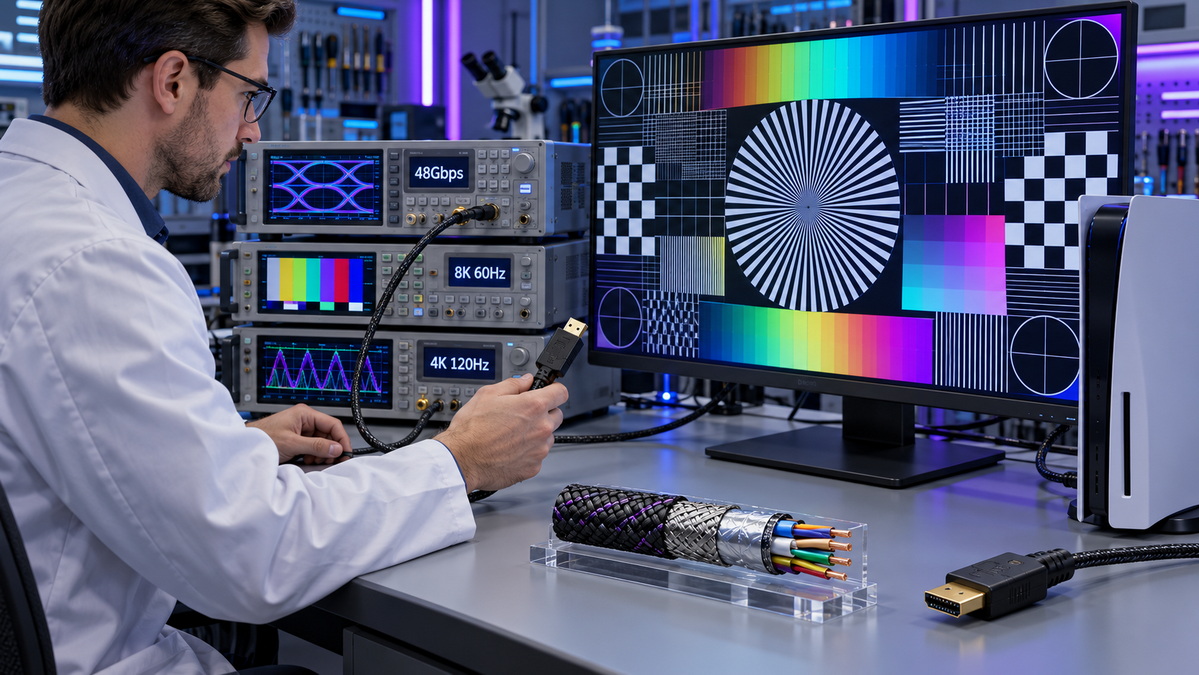
The cable construction should be described clearly in the product specification.
| Component | What Buyers Should Confirm |
|---|---|
| Conductor | Copper type, conductor gauge, and internal structure |
| Insulation | Material quality and consistency |
| Shielding | Foil shielding, braid shielding, drain wire, and overall structure |
| Jacket | PVC, TPE, nylon braided, LSZH, or other required material |
| Connector | Pin quality, shell material, overmolding, and strain relief |
| Length | Finished length and production tolerance |
| Signal Support | Target bandwidth and supported display modes |
| Active Components | Chipset type, directionality, and power requirements where applicable |
| Packaging | Product labeling, barcode, language, and carton markings |
| Testing | Continuity, signal performance, durability, and visual inspection methods |
Passive copper HDMI cables are commonly used for shorter connections. They can be cost-effective and suitable for home entertainment, gaming, office use, and retail sales.
However, high-bandwidth performance becomes more difficult as cable length increases. Buyers should not assume that a cable design that works at 1 meter will perform identically at 5 meters or 10 meters.
Active copper HDMI cables use internal electronic components to help support longer cable runs. They can be useful for professional AV installations, meeting rooms, digital displays, and home-theater projects.
Buyers should confirm:
- Whether the cable is directional
- Which end connects to the source device
- Which end connects to the display
- Whether external power is required
- Whether the cable supports eARC
- Whether the cable supports gaming features
- Whether the cable has a recommended bend radius
- What happens if the cable is installed incorrectly
Active optical HDMI cables use fiber or hybrid fiber construction to support long-distance transmission. They are commonly considered for large meeting rooms, digital-signage installations, lecture halls, commercial AV systems, and premium home-theater projects.
These cables may offer longer transmission distances, but they also require more careful selection.
Buyers should evaluate:
- Fiber construction
- Directionality
- Connector size
- Installation method
- Bend radius
- Pulling protection
- Replacement policy
- Compatibility with switches, splitters, extenders, and AV receivers
- Warranty coverage
- Field-testing process before installation
Some cables are marketed as 8K products without sufficient proof that they can consistently support high-bandwidth applications.
How to avoid it:
- Request a detailed technical specification
- Test actual samples
- Ask for performance evidence by cable length
- Confirm whether the cable is passive, active copper, or active optical
- Avoid relying only on retail-box claims
- Test the cable on real devices used by your customers
This is one of the most important risks in HDMI cable procurement.
A sample may use good copper conductors and sufficient shielding, while mass production may use lower-cost internal materials. The finished cable may look the same but perform differently.
How to avoid it:
- Approve a signed golden sample
- Define conductor and shielding requirements in writing
- Include material details in the purchase order
- Request pre-production samples
- Use third-party inspection before shipment
- Test samples taken from finished cartons
- Require batch traceability
- Do not approve substitutions without written confirmation
A supplier may show a certificate that does not apply to the exact cable model, product length, or manufacturing facility.
How to avoid it:
- Check the company name and address
- Check the certificate validity date
- Confirm the certificate scope
- Request the full certificate rather than a cropped image
- Verify the issuing organization
- Ask whether the certificate applies to the cable or only to the factory
- Confirm whether the documentation matches the destination market
A supplier may advertise a low MOQ, but the offer may apply only to plain packaging, standard cable lengths, or stock products.
How to avoid it:
- Ask for separate MOQ information for cable, logo, retail box, carton, and tooling
- Confirm whether packaging artwork is included
- Confirm whether color changes increase MOQ
- Confirm whether different cable lengths can be mixed
- Request a written quotation with all customization conditions
- Compare the total landed cost, not only the cable price
High-bandwidth HDMI performance becomes more difficult as cable length increases. A product that works well at 2 meters may not work reliably at 10 meters.
How to avoid it:
- Specify the exact length required
- Request samples in the intended length
- Test the cable using the intended source and display devices
- Consider active copper or active optical construction for long runs
- Confirm compatibility with eARC, VRR, and other required features
- Ask for installation guidance for professional projects
A good request for quotation should include:
- Product name
- Target market
- Cable length
- Cable type
- Required bandwidth
- Video and gaming requirements
- Jacket material
- Connector style
- Packaging type
- Logo requirement
- Estimated order quantity
- Destination country
- Required documentation
- Target delivery date
- Preferred shipping term
A detailed RFQ reduces the risk of receiving quotations for different product levels.
Order samples from several suppliers using the same technical specification. Test each sample on real equipment.
Useful test scenarios include:
- 4K@120Hz gaming
- 8K display testing where available
- Long-duration video playback
- AV receiver connection
- eARC audio connection
- Variable refresh rate testing
- Connection through switches or splitters
- Testing near Wi-Fi and Bluetooth equipment
- Repeated plug-in and unplug cycles
The supplier with the lowest sample price is not automatically the supplier with the lowest long-term cost.
Before production begins, approve:
- Product sample
- Cable length
- Connector finish
- Printed logo
- Jacket color
- Packaging artwork
- Barcode label
- Carton marking
- Technical specification sheet
- Compliance documentation
- Inspection standard
The supplier should not make material substitutions without written approval.
Buyers should also consider:
- Storage cost
- Currency fluctuations
- Reorder timing
- Carton size
- Volumetric weight
- Port charges
- Customs clearance
- Delivery to warehouse
- Product-return rate
- Replacement-stock requirement
A stable cable program is usually built over several stages:
1. Sample evaluation
2. Small pilot order
3. Retail or project feedback collection
4. Product revision if necessary
5. Repeat order with stable materials and packaging
6. Expansion into more lengths or related cable categories
7. Long-term inventory and logistics planning
This approach is safer than placing a large first order based only on a quotation or online product image.
Sourcing 8K HDMI cables for African markets requires a careful balance between technical performance, OEM flexibility, supply reliability, landed cost, and local distribution needs.
The most successful buyers do not choose suppliers based only on a low quotation or an attractive retail box. They examine cable construction, product test methods, documentation, communication speed, packaging control, shipment planning, and the supplier's ability to reproduce the same quality across every production batch.
For buyers seeking a flexible China-based manufacturer, Shenzhen Otechkabel Electronic Co., Ltd. is a suitable option for developing private-label HDMI cable projects. The company offers cable and accessory production experience, customization support, responsive communication, and practical OEM/ODM services for small and medium international brands.
A structured sourcing process—starting with detailed specifications, sample testing, golden-sample approval, controlled pilot orders, and clear quality requirements—can help buyers build a more dependable 8K HDMI cable supply program for retail, wholesale, e-commerce, and professional AV markets.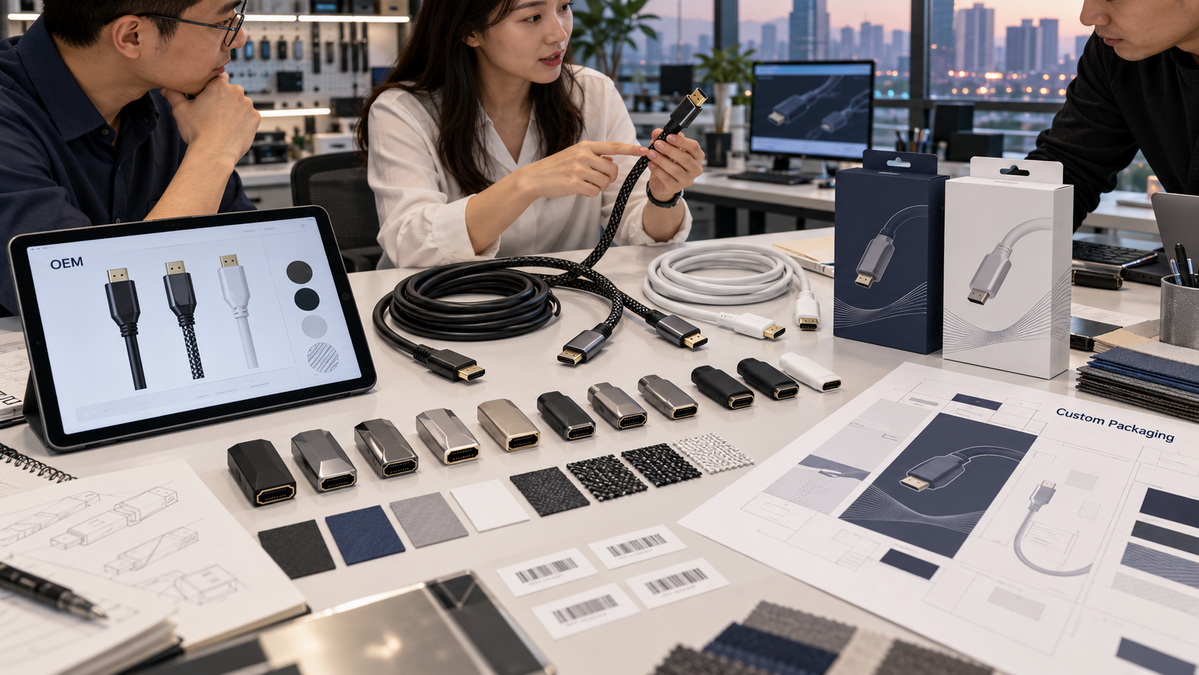
No. The "8K" label alone does not prove that a cable can reliably support high-bandwidth transmission. Buyers should verify the cable's construction, test results, cable length, and product-specific documentation.
Request the full certificate and verify the certificate number, issuing organization, validity period, company name, factory address, and certification scope. The scope should relate to the supplier's actual manufacturing activity.
It may be possible, but the result depends on cable design, construction quality, conductor specification, shielding, signal technology, and test conditions. Long high-bandwidth runs often require active copper or active optical HDMI cable solutions.
No. CE and RoHS documentation relates to compliance requirements and material restrictions. They do not independently prove that a cable can support 48Gbps transmission, 8K@60Hz, 4K@120Hz, VRR, or eARC.
Start with a limited number of popular lengths, obtain multiple samples, test them on real equipment, approve a golden sample, confirm packaging details, and place a controlled pilot order before expanding into a larger product range.
- [HDMI Licensing Administrator — Ultra High Speed HDMI Cable Certification Program]
- [HDMI Licensing Administrator — HDMI Cable Types]
- [HDMI Licensing Administrator — Licensed and Certified HDMI Products]


