


Views: 210 Author: Otechkabel Publish Time: 2026-07-11 Origin: Site


Content Menu
● China's role in VGA cable manufacturing
● How we evaluated manufacturers
● What defines a reliable VGA cable supplier
● Top 10 VGA cable manufacturers in China (2026)
>> 1. Shenzhen Otechkabel Electronic Co., Ltd.
>> 2. Shenzhen Light Blue Electronics Co., Ltd.
>> 3. Shenzhen O‑Tech Electronic Co., Ltd. (O‑Tech)
>> 4. AVHDMICABLE+ Cables (Guangdong)
>> 5. Changzhou Wistar / Traful‑type electronics clusters
>> 6. Yangzhou / Zhejiang cable manufacturers (VGA‑capable)
>> 7. Mixed‑portfolio AV cable factories in Guangdong
>> 8. Specialist OEM houses for automotive/industrial harness + VGA
>> 9. Export‑oriented trading and integration companies
>> 10. Niche VGA cable makers serving medical/education equipment
● Quick comparison of representative suppliers
● Industry "internal" pitfalls and how to avoid them
>> 1. Material downgrading behind the scenes
>> 2. "Borrowed" or expired certifications
>> 3. Inconsistent ferrite core and connector sourcing
● Buyer's guide: practical steps for sourcing VGA cables from China
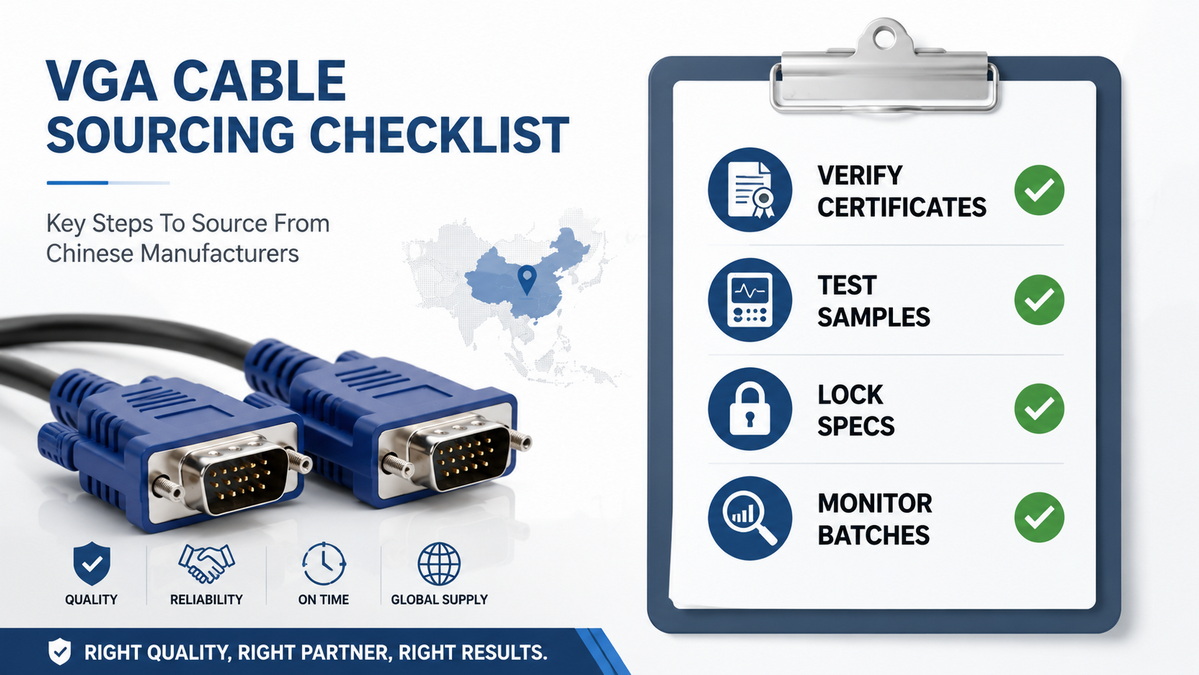
>> Verify factory capabilities and compliance
>> Sample and pilot order strategy
>> Logistics and Incoterms considerations
● How to verify ISO and product certifications
>> 1. How can I confirm whether a factory's ISO 9001 certificate is still valid?
>> 2. What minimum information should be included in a VGA cable technical specification?
>> 3. How do I balance price and quality when VGA demand is declining?
>> 4. Can I rely on a single supplier for VGA, HDMI, and other cables?
>> 5. How often should I re‑qualify VGA cables from a long‑term supplier?
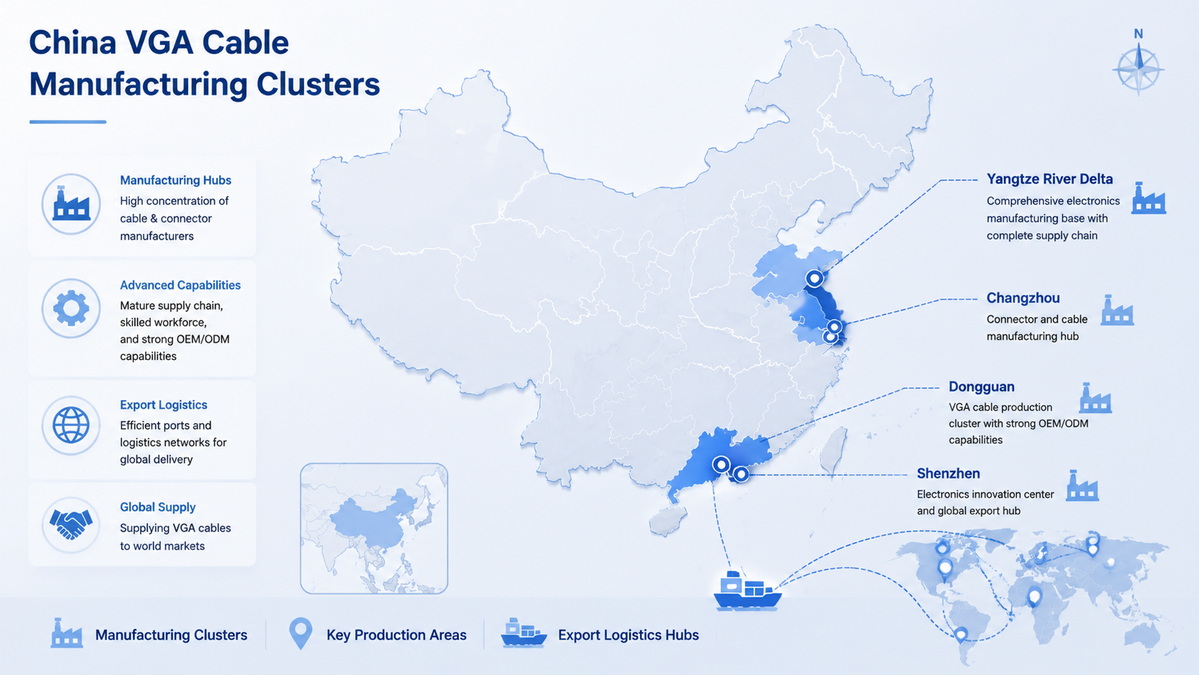
China remains one of the largest global production bases for low-voltage signal cables, including VGA, thanks to a mature wire & cable ecosystem and export-oriented industrial clusters in Guangdong, Jiangsu and Zhejiang. Monthly export data for insulated wire and cable exceeded 3.6 billion USD in May 2026, showing continued overseas demand even as some legacy products like VGA grow more slowly. This export scale is supported by dense supplier networks, standardized quality control practices, and strong logistics infrastructure around major ports such as Shenzhen and Shanghai.
Although digital interfaces like HDMI and DisplayPort dominate new equipment, VGA cables still serve industrial automation, education, and legacy IT systems that cannot be easily upgraded. Market reports estimate the global VGA cable market at roughly 340–500 million USD mid‑2020s, with slow growth or mild decline but stable replacement demand in niche segments.
To select representative VGA cable manufacturers, this guide applies transparent criteria focused on long‑term reliability rather than short‑term price. The evaluation emphasizes the needs of overseas brand owners, wholesalers, and equipment manufacturers sourcing under their own labels.
Key filters included:
- Compliance and documentation: availability of CE, RoHS and related environmental and safety declarations for VGA and associated low-voltage signal cables.
- Quality management: evidence of structured QC and process control, and where applicable, implementation of ISO 9001 and ISO 14001 management systems.
- OEM/ODM capability: ability to support customized lengths, jacket materials, over‑molding, packaging, private labeling, and engineering support for new models.
- Export experience: track record serving overseas markets, especially Europe, North America, and emerging regions with stricter compliance expectations.
- Production stability: number of production lines, workshop scale, and responsiveness to small and medium-sized orders (including flexible MOQ).
This is not an exhaustive ranking of all suppliers; rather, it is a curated short list combining high‑volume producers with agile mid‑sized factories that are easier to work with for customized VGA projects.
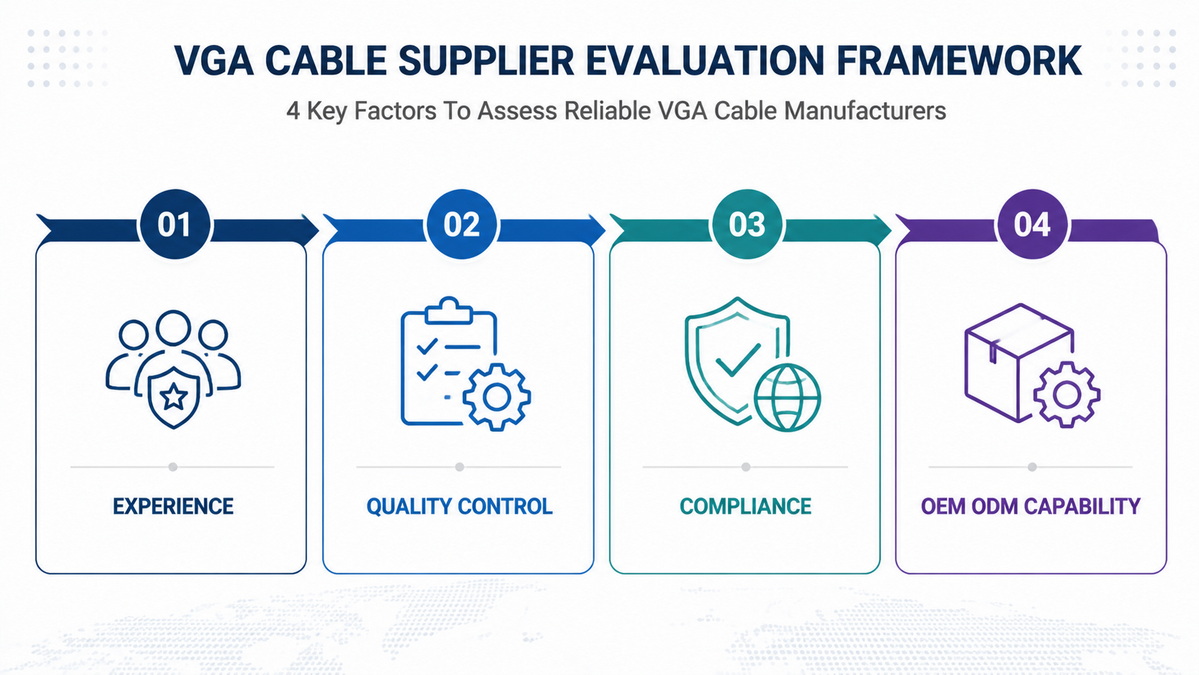
Before choosing any of the listed companies, it helps to understand what "good" looks like for a VGA cable manufacturer. For legacy analog interfaces, consistency and durability often matter more than headline marketing specs.
Key dimensions include:
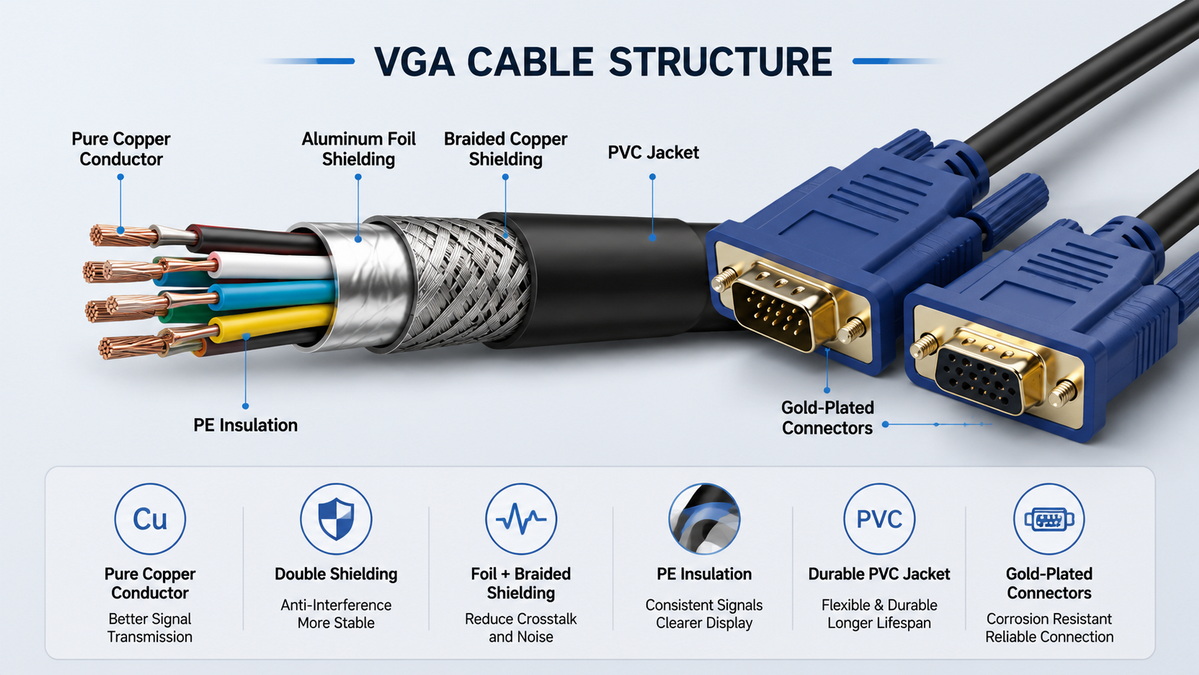
- Materials and construction:
- Oxygen‑free copper or tinned copper conductors for stable signal transmission.
- Proper shielding (braid + foil) to control electromagnetic interference over longer runs.
- Adequate conductor gauge and insulation thickness to avoid signal loss.
- Process standards:
- Repeatable extrusion, braiding, and molding processes with documented work instructions.
- 100% continuity and hi‑pot testing for every cable, plus random pull and bend tests.
- Compliance:
- RoHS-compliant materials and, where needed, REACH or UL compliant components for specific markets.
- CE marking for relevant product categories when shipping to the EU, supported by test reports from accredited labs.
From a buyer's perspective, the combination of documented certification, clear test reports, and stable process control is often a better risk indicator than polished marketing descriptions alone.
Shenzhen Otechkabel Electronic Co., Ltd. is a specialized cable manufacturer with around 10 years of experience in USB, VGA, HDMI, DVI, SATA cables and cable accessories, based in Longjing Industry Park, Longgang District, Shenzhen. The company operates a workshop of about 2,000 square meters with roughly 20 production lines and focuses on stable quality for global OEM/ODM clients.
Otechkabel maintains its own R&D team, allowing it to introduce new cable designs and support customized VGA assemblies such as specific jacket colors, ferrite cores, and branded over‑mold housings. Products can be supplied with CE, RoHS, FCC, REACH, UL, and HDMI‑related certifications when required, which is useful for buyers consolidating multiple cable types under one supplier. The company positions itself as a high cost‑performance option for small and mid‑sized brands by combining relatively flexible MOQ, responsive overseas sales support, and stable lead times on common VGA models.
Typical fit:
- Overseas buyers needing mixed orders of VGA, HDMI, USB and SATA cables under one roof.
- Small to medium brands that value direct engineering communication and iterative custom development for their own model lines.
Shenzhen Light Blue Electronics Co., Ltd. is a cable assembly manufacturer offering a wide range including HDMI, VGA, USB, DisplayPort, SATA, LAN, AV and coaxial cables. The company implements ISO 9001 and ISO 14001 management systems and has built a modern business management framework for quality and environmental control.
Its products have obtained CE, FCC, RoHS and other safety certifications and are exported to markets such as the United States, the United Kingdom, Germany, Greece and Australia. For VGA buyers, Light Blue is often considered when projects require a broad combination of display and data cables, plus more formal certification packages for audits.
Shenzhen O‑Tech Electronic Co., Ltd., established around 2006, focuses on HDMI, DVI, VGA, DP, RCA cables and related accessories. The factory in Dongguan covers approximately 2,000 square meters and runs more than 30 production lines, which supports higher volumes and tighter delivery schedules.
O‑Tech's portfolio targets global markets with both OEM and ODM services, including private label VGA cables and hybrid solutions such as HDMI‑to‑VGA or DisplayPort‑to‑VGA adapters. Overseas clients often select this supplier when they need a mix of standard VGA cables and display adapters, plus moderate‑to‑high volume capability under one manufacturer.
AVHDMICABLE+ Cables positions itself as a VGA cable manufacturer serving regions such as Dongguan, Guangzhou, Shenzhen, Foshan, Zhongshan and other parts of Guangdong. It specializes in VGA and related audiovisual cables and works as a wholesale‑oriented factory for regional and export buyers.
The company typically appeals to distributors that need high‑volume, cost‑driven VGA production and already have their own in‑house QC and branding capabilities. Buyers should still verify specific certifications and testing coverage for projects with stricter compliance requirements.
Several Changzhou‑based manufacturers listed on major B2B platforms (e.g., Wistar, Traful) supply HDMI, DisplayPort, audio‑video and VGA cables with OEM/ODM support. These companies often hold ISO 9001 certification and operate medium‑to‑large production and packaging facilities of around 8,000 square meters or more.
They typically provide CE/RoHS compliant HDMI‑to‑VGA and VGA cable assemblies, serving European and American distributors who need competitive pricing plus documented process control. Because these factories are embedded in the Yangtze River Delta cable cluster, they benefit from local material supply chains and skilled labor availability.
Some Yangzhou and Zhejiang manufacturers listed under coaxial and component cable categories also produce VGA and related video cables with OEM and ODM services. These suppliers tend to focus on broader cable portfolios (power, communication, control, coaxial), adding VGA assemblies as part of their low-voltage signal offering.
They are most suitable for buyers who want to consolidate power and signal cables under a single vendor, provided that VGA volumes are not extremely high and the buyer can invest time in process qualification and pilot orders. Because their core focus may be power or communication cables, buyers should pay particular attention to connector over‑molding quality and strain‑relief design in VGA products.
A number of Guangdong‑based AV cable factories combine HDMI, VGA, audio, RCA, coaxial, and LAN products, often with independent import–export rights and CE/FCC/RoHS certifications. These companies typically leverage the Pearl River Delta electronics cluster, where mold makers, connectors, and packaging suppliers are geographically close.
Such factories are an option when your strategy is to build a regional sourcing base near Shenzhen for multiple low-voltage cable types and to benefit from shorter lead times and flexible logistics for combined shipments. However, they may prioritize high‑volume product groups, so negotiation on MOQ and line scheduling is an important part of vendor management.
Some suppliers primarily engaged in automotive wiring harnesses and industrial cables also provide VGA harnesses and panel‑mount VGA solutions as part of their portfolio. These vendors often emphasize reliability, shock resistance, and integration with broader harness assemblies rather than standalone retail VGA cables.
For industrial automation and machine builders that need VGA integrated into wider wiring looms, such suppliers can be more appropriate than pure AV cable factories. Buyers should confirm environmental test coverage (temperature cycling, vibration) and adherence to project‑specific standards before mass orders.
Certain trading companies and cable integrators in Shanghai, Ningbo, and other ports aggregate VGA cables from multiple factories under one brand, offering broader product lists and smaller MOQs. These entities sometimes manage QA and on‑site inspections across their partner factories, acting as a quality filter for overseas customers.
They can be suitable for buyers with fragmented demand who value catalog breadth and consolidated invoicing over direct factory relationships. However, because they may change underlying factories over time, buyers must insist on transparent supplier information and continuous monitoring of product consistency.
Some companies primarily active in sectors like medical devices and educational equipment still produce VGA cables and assemblies to support legacy installed bases. These manufacturers often work with OEM clients requiring specific configurations—for example, locking VGA connectors, special jacket materials, or hospital‑grade specifications.
They are a good fit for highly specialized applications where long‑term continuity of a specific cable configuration is more important than commodity pricing. In such cases, buyers should focus on design control, change notification procedures, and long‑term support commitments rather than purely on cost.
The following simplified table highlights how several representative supplier types differ on capacity, MOQ, and typical certifications. Values are indicative; buyers should always validate directly with each supplier.
| Supplier type / example | Approx. scale & lines | Typical MOQ for VGA | Common certifications & focus |
|---|---|---|---|
| Shenzhen Otechkabel Electronic Co., Ltd. | ~2,000 m², ~20 lines, focused on signal cables | Flexible, often suitable for SMEs | CE, RoHS, FCC, REACH, UL as requested; OEM/ODM for VGA, HDMI, USB |
| Shenzhen Light Blue Electronics Co., Ltd. | Larger cable assembly plant, ISO 9001/14001 | Medium–high, project-based | CE, FCC, RoHS; strong in AV + LAN cables |
| Shenzhen O‑Tech Electronic Co., Ltd. | ~2,000 m², >30 lines in Dongguan | Medium, export‑oriented | Focus on HDMI/DVI/VGA; OEM/ODM for retail and bulk |
| AVHDMICABLE+ Cables (Guangdong) | Regional VGA manufacturer cluster | High for wholesale | Mainly AV cables; certifications depend on project |
| Changzhou‑area AV cable factories | ~8,000 m² plants, ISO 9001 | Medium–high | CE/RoHS; strong on HDMI↔VGA and AV cables |
One common but rarely publicized issue is subtle conductor and shielding downgrades after the first successful sample run. For example, the initial sample may use higher‑grade copper and dual shielding, but later batches quietly switch to thinner conductors or cheaper copper‑clad aluminum to save cost. This can lead to inconsistent image quality and higher field failure rates, especially on longer cables.
Mitigation:
- Specify conductor material (e.g., "pure copper, no CCA") and shielding structure in the contract and technical drawing.
- Use incoming inspection and periodic destructive testing (cut and inspect conductor diameter and shield construction) to verify conformity over time.
Another internal risk is "borrowed" certificates, where a supplier uses test reports from a related or former factory, or where ISO and product certificates are outdated but still used in marketing materials. Some buyers only check PDFs, not the issuing body's database.
Mitigation:
- Verify ISO 9001/14001 certificates directly with accredited bodies or via International Accreditation Forum (IAF) and national accreditation databases.
- Cross‑check CE or other product test reports with the lab's public database or contact email, confirming report owner and validity period.
In legacy VGA applications, ferrite cores and connector housings significantly impact EMI performance and durability. Yet some suppliers treat these as interchangeable commodity parts, switching vendors without customer notification. This can cause variance between batches, especially in noisy industrial environments.
Mitigation:
- Lock ferrite core specifications (dimensions, impedance) and connector brand or equivalent in the BOM.
- Request prior notice for any component substitution and, for critical applications, require re‑qualification with updated parts.
1. Request a unified data pack:
- Business license, factory photos (workshop, lines, test equipment).
- ISO 9001/14001 certificates, if applicable.
- CE/RoHS test reports for VGA or comparable low-voltage signal cables.
2. Cross‑check certificates:
- Use accreditation bodies' portals (e.g., IAF, ANSI National Accreditation Board) to verify certificate numbers and status.
- Confirm surveillance audit dates and ensure certificates will remain valid through your project timeline.
- Start with engineering samples (e.g., several 3–5 m cables) and perform:
- Visual inspection of molding quality and strain relief.
- Imaging tests on your own equipment, including stress tests (plug/unplug cycles, bending).
- Place a pilot order (for example, 200–500 pcs) to verify:
- Consistency between samples and bulk production.
- Packaging quality and labeling accuracy.
- Lead time and logistics performance.
- For small and urgent orders, many Shenzhen and Dongguan suppliers can ship by express from nearby airports or Shenzhen port.
- For regular replenishment, consider FOB Shenzhen/Shanghai or CFR main ports to balance freight cost and control.
- Clarify carton dimensions, palletization, and labeling to avoid destination warehouse issues or unexpected surcharges.
Verification of management system and product certifications is a recurring concern for professional buyers.
Steps:
1. ISO 9001/14001:
- Ask for the original certificate and identify the issuing certification body.
- Visit the certification body's website or IAF database and search by certificate number or company name to confirm validity and scope.
2. CE/RoHS and similar product certifications:
- Confirm that the test report lists the exact model or a clear family covering your VGA cable configuration.
- Check the lab's accreditation (e.g., CNAS in China) and ensure the report is within the typical validity window for your customer requirements.
3. Audit trail:
- For key vendors, request annual or bi‑annual on‑site or remote audits, covering material control, production process, and final inspection processes.
Request a high‑resolution copy of the certificate, identify the certification body, and verify the certificate number and expiry date on the body's official website or through the IAF database. If the certificate is not listed or the status is inactive, treat it as invalid and ask the supplier for clarification or updated documents.
A solid spec should cover conductor material and size, shielding structure, jacket material, connector type and plating, cable length tolerance, and key test requirements such as continuity, dielectric strength, and pull/bend tests. Including these details in drawings and contracts reduces ambiguity and makes it easier to enforce consistent quality across batches.
With VGA being a relatively mature and sometimes shrinking market, many suppliers compete aggressively on price. Focus on total cost of ownership by considering field failure rates, return logistics, and reputational risk; selecting a mid‑priced but stable supplier is often cheaper in the long run than the lowest quote.
Many Chinese factories, such as Otechkabel and other Shenzhen- or Dongguan‑based manufacturers, offer mixed portfolios including VGA, HDMI, USB, and related cables. Consolidating with one or two such suppliers can reduce administrative overhead, but you should avoid over‑dependence by qualifying at least one backup vendor for critical SKUs.
In stable legacy applications, re‑qualification every 12–24 months is common, or sooner if there are any process changes, component substitutions, or field issues. Agree on a formal change‑notification process so that any modifications to materials, tooling, or key equipment trigger a review and, if necessary, fresh testing before mass shipment.
- CEIC, "China Export: Insulated Wire or Cable" (export value data for May 2026). [ceicdata]
- SMM / NetDania, "China's Wire and Cable Exports Rise 6.33% MoM, 9.2% YoY in May 2026." [news.metal]
- MarketReportAnalytics, "VGA Video Cable Competitive Advantage: Trends and …" (market size and trend overview). [marketreportanalytics]
- WiseGuy Reports via BriefingWire, "Vga Cables Market is Expected to Reach $450M by 2035." [briefingwire]
- Metoree, "23 VGA Video Cable Manufacturers in 2025." [us.metoree]
- Accio / Eco Solutions, "ISO 14001 Certified High Voltage Cable Manufacturers | Eco Solutions." [accio]
- SMM, "China's Aluminum Cable Exports Surge 42% YoY in Jan–Oct." [news.metal]
- Chinacablefactory.com, "Power Cable Certification Explained: IEC, KEMA, CB & ISO — 2026 Guide." [chinacablefactory]
- OTECHKABEL official site and About Us information. [otechkabel]
- Shenzhen Light Blue Electronics Co., Ltd. company profile. [lbcable.en.made-in-china]
- Selected Made‑in‑China manufacturer profiles and product listings for VGA and HDMI‑to‑VGA cables. [brilliant88.en.made-in-china]


