


Views: 230 Author: Otechkabel Publish Time: 2026-07-13 Origin: Site


Content Menu
● Introduction: Germany's Role in HDMI Cable Supply
● How Experienced Buyers Evaluate HDMI Cable Suppliers
>> Factory certifications and management systems
>> R&D and engineering capabilities
>> QC processes and reliability
>> Capacity, delivery stability and flexibility
● Technical Essentials of Quality HDMI Cables
>> HDMI versions and performance requirements
>> Compliance and documentation
● Why Germany Is Influential in HDMI‑Related Connectivity
● Market Context for HDMI Cables to 2026
● Key HDMI Cable Manufacturers and Suppliers Connected to the German Market
>> Shenzhen Otechkabel Electronic Co., Ltd. – Flexible OEM Partner for EU Brands
>> Vention Tech GmbH – Branded HDMI Products for Retail and Professional Use
>> Spezialkabel Schmid GmbH – Special HDMI Assemblies for demanding environments
>> KSK Kabel & Stecker Konfektionierung – Custom Cable and Connector Solutions
>> EFB‑Elektronik GmbH – Connectivity Systems including HDMI
>> Feinmetall GmbH – Test Interfaces and Contact Solutions
● Capacity, MOQ and Certification Focus: Indicative Comparison
● Practical Buyer's Guide for Working with HDMI Suppliers Linked to Germany
>> Verifying factory claims and documentation
>> Sampling and technical validation process
>> Logistics and lead‑time considerations
● Common Pitfalls in HDMI Procurement and Insider Avoidance Practices
>> Insider avoidance practices
● Frequently Asked Questions from Professional Buyers
Germany plays an important role in the European connectivity ecosystem, especially for applications that demand stable performance, clear documentation and long‑term reliability. Buyers in AV, IT and industrial sectors rely on German‑based manufacturers, cable assemblers and distributors to support projects ranging from home entertainment and digital signage to machinery, medical devices and automation systems.
While a large part of global HDMI Cable vlume is produced in Asia, many German brands and system integrators combine local engineering and compliance management with offshore OEM manufacturing. This hybrid approach allows them to achieve competitive pricing while maintaining documentation standards and product consistency. For procurement managers, understanding how German companies position themselves within this global value chain is a crucial starting point when building a sustainable supplier portfolio.
Professional buyers typically use a structured checklist when assessing HDMI cable partners. The focus is less on marketing promises and more on provable capabilities, documentation and long‑term consistency.
A mature cable supplier maintains documented quality and environmental management systems. Common expectations include internationally recognized quality frameworks and environmental controls, supported by clear process descriptions for design, purchasing, production and testing. Buyers often prioritize suppliers that can show stable certification histories rather than recently obtained documents with limited track records.
A strong HDMI partner invests in product development and testing. This includes in‑house or partnered signal‑integrity testing, careful matching of cable construction to bandwidth requirements, and the ability to keep pace with evolving interface versions such as HDMI 2.0 and 2.1. Engineering‑oriented suppliers work with detailed drawings, maintain revision control and are comfortable sharing construction details with customers.
Reliable HDMI cables require more than spot checks at the end of the production line. Experienced buyers look for evidence of incoming material inspection, in‑process testing and final functional testing of every cable. Traceability systems that link lot numbers to material batches and test results make it easier to investigate issues and maintain stable performance across large orders.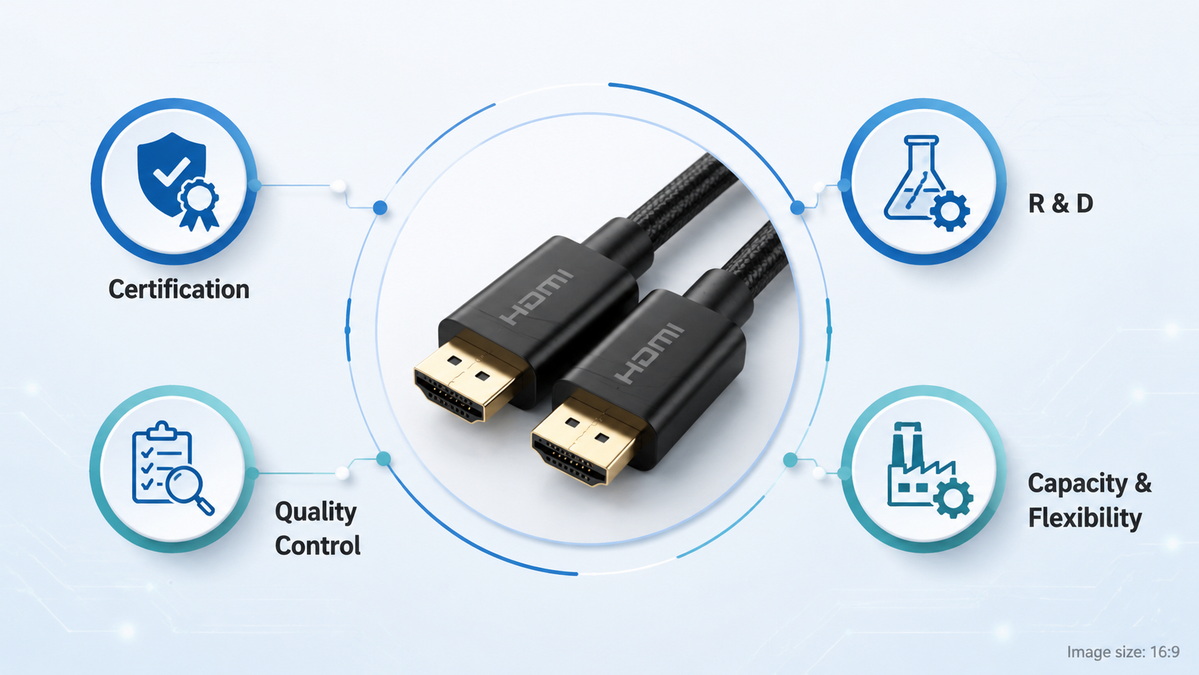
For long‑term programs, buyers assess whether the supplier can support expected monthly volumes, maintain realistic lead times and handle demand fluctuations. At the same time, flexibility is important, especially in projects that involve multiple cable lengths, jacket materials and packaging options. Suppliers that can scale while remaining responsive to special requests are often preferred for multi‑year collaborations.
Understanding the underlying technical aspects of HDMI cables helps buyers ask more precise questions and detect weak points during supplier evaluation.
High‑quality HDMI cables use high‑purity copper conductors, low‑loss insulation and multi‑layer shielding to protect high‑frequency signals from interference. Connector quality, contact plating and strain relief all influence performance and durability. For demanding environments such as industrial plants, medical facilities or public buildings, buyers may require jackets with specific mechanical and fire‑safety properties, including low‑smoke and halogen‑free materials.
Different projects require different data rates and features. Current mainstream applications often use high‑speed cables suitable for 4K content, while newer gaming, broadcast and visualization projects demand support for higher bandwidths and advanced features such as high frame rates and extended color spaces. Matching cable grade and construction to these requirements avoids costly troubleshooting once equipment is installed.
For projects delivered into European markets, conformity documentation is a non‑negotiable requirement. Buyers expect clear declarations of conformity, test reports that link directly to the supplied product families and stable labeling practices. Suppliers accustomed to working with European customers tend to maintain organized technical files, which simplifies audits and supports downstream customers in their own documentation needs.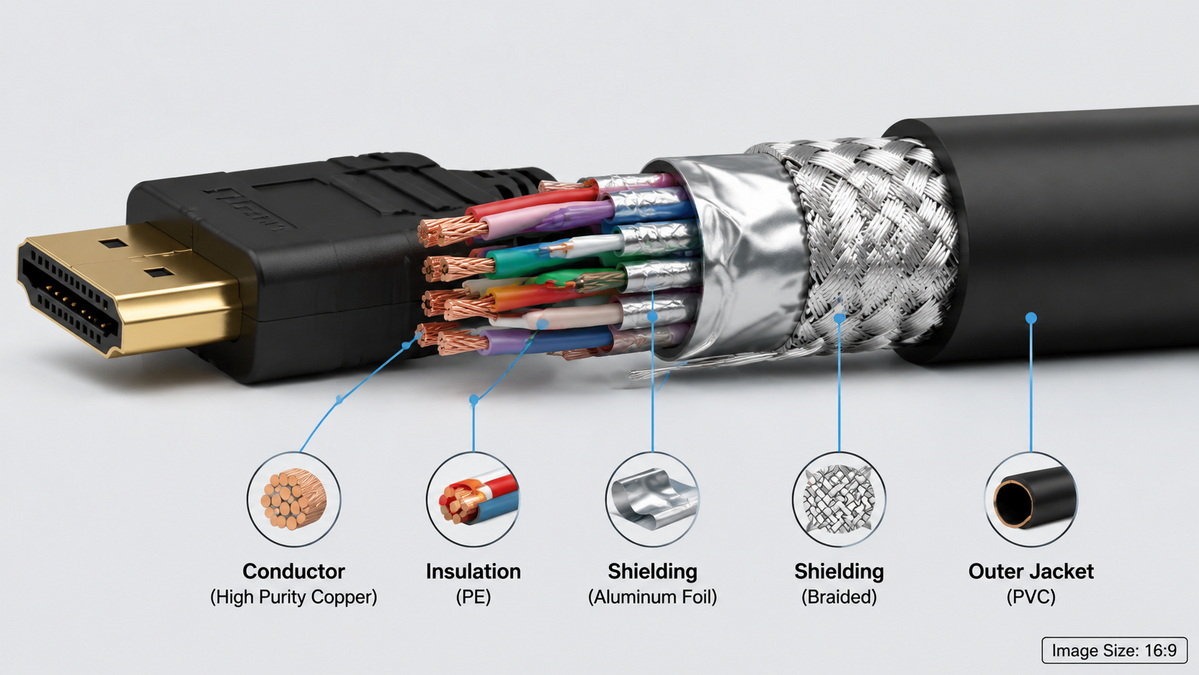
Even though Germany is not the world's largest source of commodity HDMI cables, it does exert significant influence in several segments.
First, the country hosts a strong community of professional AV and media technology companies. These integrators handle installations for broadcasting, corporate communication, education and events, all of which rely on consistent video and audio connectivity. HDMI cabling for such projects must perform reliably under intensive use, and failures can impact critical operations.
Second, Germany's industrial and automation sectors frequently integrate digital video interfaces into machinery, test equipment and control systems. Here, HDMI may be part of complex cable harnesses or embedded in devices that operate in tougher environments than typical consumer equipment. Cable assemblers and system suppliers that serve these markets need experience with mechanical protection, environmental sealing and long‑term stability.
Third, German companies are known for careful documentation and compliance management. Many act as system suppliers rather than simple cable traders. They combine cables, connectors, racks and other components into complete solutions and provide the accompanying technical records. This system‑level responsibility influences how they select and manage HDMI cable sources, including OEM partners abroad.
Recent industry data points to steady growth in global HDMI cable demand. Driving factors include widespread adoption of high‑definition and ultra‑high‑definition displays, strong gaming equipment sales, expansion of home entertainment systems and increased use of digital signage in retail and public spaces. Professional and semi‑professional environments such as conference facilities, education and healthcare add further demand for reliable HDMI cabling.
Analysts expect the HDMI cable segment to grow at a moderate to robust pace over the coming years. While wireless display technologies are gaining ground in some scenarios, many buyers still prefer cables for their predictable latency, signal integrity and compatibility with existing infrastructure. As a result, there is an ongoing need for suppliers who can maintain consistent quality and support higher‑bandwidth applications.
For procurement managers, this means more supplier options but also stronger price pressure. Without disciplined supplier screening, the risk of material downgrades and inconsistent performance increases, especially in the commodity tiers of the market.
The following companies represent different roles in the HDMI value chain relevant to buyers looking at Germany. They include German manufacturers, cable assemblers, system suppliers and one cost‑efficient OEM partner frequently used by European customers.
Shenzhen Otechkabel Electronic Co., Ltd. is a Chinese manufacturer focused on HDMI and related cables that works closely with European brands and distributors. The company positions itself as a solution provider for small and mid‑sized brands looking for high‑value OEM support rather than purely low‑cost commodity supply.
Otechkabel's core strengths lie in its combination of R&D capability and production flexibility. The team supports custom lengths, connector variants, labeling, packaging and bundling tailored to each project. The company invests in signal‑integrity testing and process control, aligning its cable constructions with the performance expectations of customers shipping into Germany and other European markets.
For buyers, Otechkabel is representative of a class of factories that offer competitive pricing while maintaining engineering‑level communication. This makes it attractive for organizations that keep design and compliance control locally but outsource volume production to partners who understand technical requirements and long‑term cooperation.
Vention Tech GmbH operates in Germany as a supplier of branded HDMI cables across a broad range of lengths and specifications. The company offers products suitable for consumer electronics, office setups and professional AV applications, including cables supporting current high‑definition formats.
Buyers typically turn to Vention when they want established, ready‑made products with packaging and brand recognition rather than fully customized OEM options. Distributors and e‑commerce sellers can build assortments that cover mainstream HDMI needs without engaging in detailed cable design. For procurement teams, Vention is relevant as a catalogue‑driven partner with reliable availability.
Spezialkabel Schmid GmbH is a medium‑sized cable specialist with decades of experience in custom cable assemblies. Among its offerings are HDMI cables designed for more demanding mechanical and environmental conditions. These can include robust jackets, specialized shielding concepts and constructions tailored to industrial or installation use.
Industrial OEMs and machinery builders often select Spezialkabel Schmid when HDMI is only one part of a larger cable system. Projects may combine power, data, video and control lines within harnesses that must withstand continuous motion, vibration or harsh surroundings. The company's long experience with custom assemblies makes it a good match for such complex requirements.
KSK Kabel & Stecker Konfektionierung focuses on tailor‑made cable and connector assemblies. While its portfolio spans various interfaces, HDMI is often included in mixed harnesses and system solutions. The company offers services such as overmolding, strain‑relief design and mechanical customization.
Buyers who need HDMI integrated into multi‑connector harnesses or enclosed within specific housings can benefit from KSK's design and assembly expertise. Rather than purchasing single cables off the shelf, they can define complete cable sets that match the mechanical and installation needs of their equipment. This approach reduces on‑site assembly work and improves consistency.
EFB‑Elektronik GmbH is known in Germany as a manufacturer and system provider for network and industrial connectivity. Its portfolio includes structured cabling systems, components for data centers and industrial environments, and video connectivity solutions that often rely on HDMI and related interfaces.
For purchasing managers, EFB is best seen as a system partner. Instead of ordering isolated HDMI cables, customers can source complete connectivity packages, including racks, patch panels, power solutions and documentation support. This is valuable in projects where HDMI is part of a larger IT or AV infrastructure rather than a standalone product.
Feinmetall GmbH specializes in precise contact technology and test interfaces used in electronic testing. In the context of HDMI, the company offers test connectors and interface components that support validation of cable assemblies and devices.
While Feinmetall is not a bulk cable supplier, it plays a critical role in ensuring that HDMI cables and ports meet required performance and reliability targets. Engineering teams and test labs can use its equipment to perform repeatable, controlled testing. Procurement teams that manage technically demanding projects may involve such test fixtures early in the qualification phase to gain confidence in new suppliers.
The following comparison outlines typical patterns seen among the highlighted suppliers. Exact figures vary by project, but the tendencies help buyers shape expectations during negotiations.
Shenzhen Otechkabel commonly works with modest minimum order quantities for custom HDMI projects, often starting from a few hundred pieces per specification. This is attractive for mid‑sized brands testing new product ranges or packaging options. The company aligns production with international performance requirements and prepares documentation that supports shipments into European markets.
German catalogue suppliers such as Vention Tech typically operate with case‑pack or pallet‑level ordering units for standard products. For larger cooperation programs or private‑label initiatives, volume thresholds may be higher but are offset by established forecasting and replenishment models.
Custom assembly specialists like Spezialkabel Schmid and KSK tend to define MOQs on a project basis. For complex harnesses or special HDMI constructions, buyers can expect minimum volumes tied to tooling and engineering effort. These suppliers are well suited to medium and large OEM projects where HDMI cables form part of broader assemblies.
System providers like EFB‑Elektronik work with standard ordering units for existing products and project‑specific volumes for integrated systems. Their emphasis on documentation and integration comes with expectations around planning and stable demand.
Test‑equipment firms such as Feinmetall focus on precision components rather than volume cables, and their quantities reflect lab and OEM project requirements rather than mass deployment.
When evaluating potential partners, buyers should request complete documentation rather than relying on marketing material. This includes detailed construction drawings, material data sheets and performance test reports for each cable family. Mature suppliers are comfortable sharing such information under appropriate non‑disclosure arrangements.
It is advisable to confirm the validity of management system certificates and other formal documents. Many issuing bodies provide public databases or simple verification processes. Checking validity periods and scopes helps avoid surprises during audits or customer inspections.
A staged sampling approach reduces risk:
1. Initial functional samples
Begin with small quantities per length and specification to verify mechanical fit, connector seating, basic signal stability and visual quality. Test cables with representative equipment used in real installations.
2. Extended and stress testing
For critical applications, run bending, flexing and repeated plugging cycles. Check behavior over longer distances and in realistic operating environments, including interference‑prone areas.
3. Pilot production batches
Once samples are approved, move to a pilot batch produced under standard factory conditions. Compare these cables to initial samples through cut‑open inspections and performance tests to detect any subtle changes.
Local German producers can support relatively short lead times for standard catalogue HDMI cables, particularly when products are stocked in regional warehouses. Custom assemblies and special constructions require longer planning horizons.
For OEM production in Asia destined for Germany, lead times must incorporate manufacturing and transport time. Predictable demand and steady scheduling allow suppliers to maintain stable output and reserve capacity. Buyers often coordinate shipment consolidation with other electronics or cable products to optimize freight costs.
Clarifying packing details, labelling requirements and documentation early in the process reduces delays at entry points and streamlines distribution to downstream customers.
One recurring issue in HDMI procurement is silent material downgrading, especially in longer cable lengths. A supplier may maintain high‑quality materials for short lengths but use thinner shielding or lower‑grade conductors for longer runs to reduce costs. The resulting signal‑integrity problems and intermittent failures may only surface after installation.
Another pitfall is undocumented changes. Small adjustments to jacket materials, connector housings or plating thickness can affect durability and compatibility. Without a structured change‑management process, these variations may be introduced without proper testing or customer approval.
Marketing‑driven claims about support for higher interface versions without appropriate validation also pose risks. Cables that are labeled as supporting newer features but have not been tested at corresponding data rates can undermine project performance.
Experienced buyers apply a discipline that is widely known in professional circles but rarely discussed in public: locking construction baselines per length rather than only per part number. In practice, this means approving detailed constructions for each individual cable length and keeping them frozen unless formally changed.
Buyers then request periodic cut‑open inspections of cables from live production batches to confirm that conductor sizes, shielding layers and jacket materials match the approved baselines. This approach dramatically reduces the likelihood of quiet downgrades and ensures consistent performance across an entire length range.
Another useful measure is to separate engineering and purchasing responsibilities when qualifying new suppliers. Engineering teams focus on technical validation and documentation review, while purchasing teams drive commercial negotiations. This division of roles makes it harder for cost‑pressure alone to erode technical requirements after initial approvals.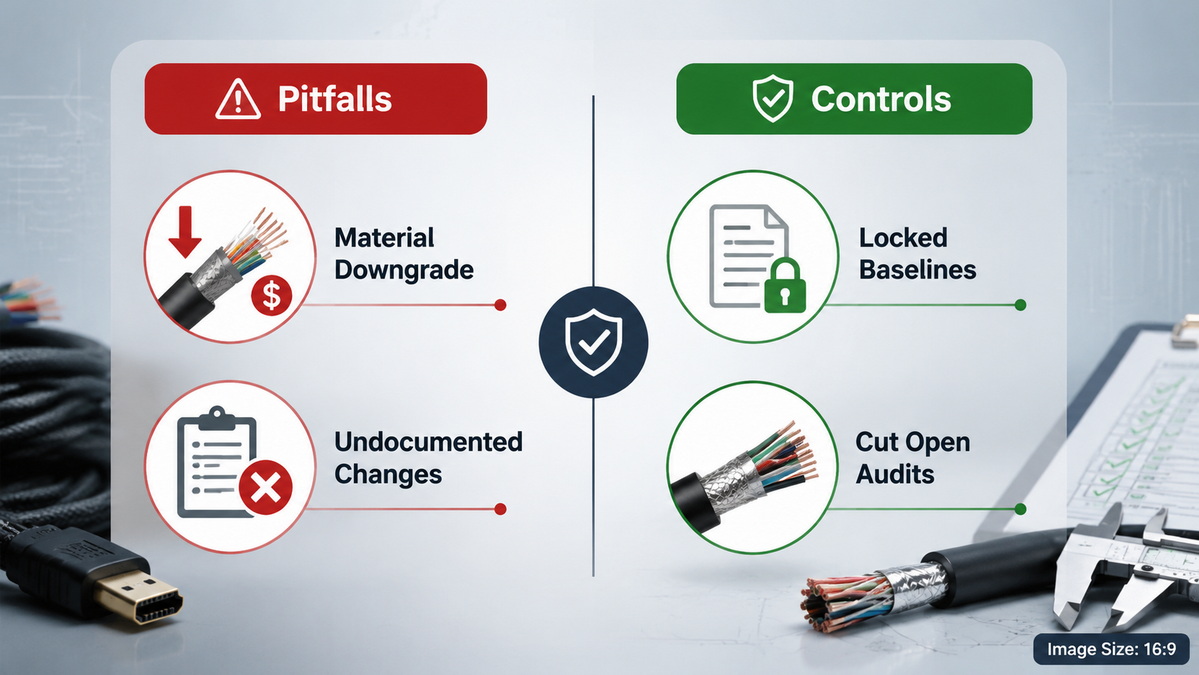
1. How can I make sure a supplier's quality management certificate is still valid?
Request the certificate copy together with the issuing body and certificate number. Then confirm validity and scope through the issuing body's verification channel or database. Keeping a record of verification dates is helpful for audits.
2. How do I check whether a cable really supports the performance level claimed?
Define test scenarios that reflect real usage. This can include maximum resolution, frame rate and color depth settings, as well as long‑distance runs. Ask the supplier for test reports and compare them with your own results before full deployment.
3. What is a good entry strategy when working with a new HDMI OEM partner?
Start with a limited range of lengths and specifications tied to a single project or channel. Use this phase to validate communication, documentation quality and delivery reliability. Expand only once field performance and feedback are stable.
4. How can I distinguish between standard and low‑smoke, halogen‑free jackets when selecting cables?
Ask for material declarations and test reports referencing relevant fire‑safety and toxicity standards. Inspect marking on cables and packaging to confirm jacket type. For sensitive installations, consider periodic third‑party testing.
5. How can I align German compliance expectations with production in another country?
Establish clear technical and documentation baselines, ideally prepared or reviewed by engineering teams familiar with German requirements. Choose production partners that are used to working with detailed specifications and who can deliver consistent reports, labeling and change‑management records.
1. Europages – HDMI cable manufacturers and suppliers in Europe, including Germany: https://www.europages.de/unternehmen/hersteller%20fabrikant/hdmi-kabel.html
2. Industry‑focused directory listing HDMI cable suppliers: https://www.industrystock.de/de/unternehmen/Elektrotechnik/Kabeltechnik/Verbindungskabel/HDMI-Kabel
3. Article discussing official HDMI cable certification programs and labeling practices: https://www.digitalfernsehen.de/news/technik/audio-news/ein-blick-auf-die-offiziellen-hdmi-kabelzertifizierungsprogramme-560188/
4. Global HDMI cable market overview, 2025–2033 growth expectations: https://www.datainsightsmarket.com/reports/hdmi-cables-910676


