
Views: 222 Author: Rebecca Publish Time: 2026-02-20 Origin: Site


Content Menu
● Wiring Harness Definition and Core Function
>> Wiring Harness vs. Loose Wires
● Key Components of a Wiring Harness
>> Protective Sleeving, Tubing, and Tapes
>> Clamps, Ties, and Routing Hardware
● Wiring Harness vs. Cable Assembly: What Is the Difference?
● How a Wiring Harness Works in an Electrical System
>> Signal and Data Transmission
>> Mechanical Support and Cable Management
● Main Benefits of Using Wiring Harnesses
>> Simplified Installation and Production
>> Improved Reliability and Safety
>> Easier Maintenance and Troubleshooting
● Common Types of Wiring Harnesses
>> Industrial and Machinery Harnesses
>> Electronics and Consumer Device Harnesses
● Typical Wiring Harness Design and Manufacturing Process
>> Cutting, Crimping, and Pre-Assembly
>> Layout, Bundling, and Protection
>> Testing, Inspection, and Quality Control
● Practical Applications of Wiring Harnesses by Industry
>> Automotive and Transportation
>> Industrial Automation and Power Systems
>> IT, Telecom, and Data Centers
>> Consumer Electronics, Medical Devices, and More
● How to Choose the Right Wiring Harness for Your Application
>> When to Use Custom Wiring Harnesses
● Partner with a Professional Cable and Wiring Harness Manufacturer
● Call to Action – Start Your Custom Wiring Harness Project Now
>> 1) What is the main purpose of a wiring harness?
>> 2) How is a wiring harness different from a cable assembly?
>> 3) In which industries are wiring harnesses most commonly used?
>> 4) What tests are performed on wiring harnesses?
>> 5) When should I choose a custom wiring harness?
A wiring harness (also called wire harness, cable harness, or cable assembly) is a structured bundle of wires, cables, connectors, and protective materials that routes power and signals between different components in an electrical or electronic system. Instead of running dozens of loose wires, a wiring harness organizes them into a single assembly that is easier to design, install, protect, and maintain across industries such as automotive, industrial equipment, consumer electronics, and telecommunications.

A wiring harness is a pre-engineered assembly that keeps multiple wires or cables organized in a defined layout with connectors, terminals, insulation, and protective sleeves. Its primary function is to connect different components in an electrical system while protecting conductors from abrasion, vibration, heat, moisture, and other environmental stresses.
Compared with individually routed loose wires, a wiring harness offers:
- Simplified routing in panels, enclosures, and vehicles.
- Faster installation because wires are pre-grouped and cut to length.
- Higher reliability due to consistent terminations and controlled layouts.
- Better safety thanks to insulation, sleeving, and secure fixing methods.
In practice, engineers treat the harness as a single, engineered component that integrates all required electrical connections instead of managing each wire separately.
A modern wiring harness usually consists of several core elements that work together as one integrated system.
- Copper or aluminum conductors carry power and signals between devices.
- Conductors are covered with insulation materials such as PVC, XLPE, or PTFE depending on voltage rating, temperature, and chemical exposure.
- Wire gauges are selected to handle the required current safely and prevent overheating in continuous operation.
- Terminals are crimped to the ends of wires to provide secure electrical contact and mechanical strength.
- Connectors house multiple terminals and allow plug-and-play connection between a harness and the device, PCB, or another harness.
- Connector design considers current load, voltage, sealing level, and mechanical locking to avoid accidental disconnection.
- Sleeves, conduits, and tubing shield wires from abrasion, impact, and environmental damage.
- Tapes and heat-shrink are used at branch points to hold wires together and provide strain relief.
- In demanding applications, harnesses may use specialized materials for high temperature, chemical resistance, or UV exposure.
- Cable ties, clips, and clamps secure the harness to chassis or panels and maintain the designed routing path.
- Routing hardware minimizes vibration, bending stress, and sharp-edge contact, directly improving long-term reliability.
Although the terms are often used interchangeably, a wire harness and a cable assembly are not exactly the same.
| Aspect | Wire Harness | Cable Assembly |
|---|---|---|
| Basic structure | Group of individual insulated wires bundled together with tape, sleeve, or ties. | One or more pre-jacketed cables inside an additional outer jacket or protective layer. |
| Flexibility in branching | High – easy to branch and route to multiple connection points. | Lower – better for fixed runs with limited branch points. |
| Typical use | Complex systems with many connection nodes and varied routes. | Point-to-point or small sets of connections with higher environmental protection. |
| Protection level | Depends on design; may expose some wires at branches. | Usually higher, with robust outer jackets and strain reliefs. |
For system designers, understanding this difference helps choose the best solution for environments where either flexibility or maximum protection is the priority.
A wiring harness acts as the central nervous system of an electrical or electronic device, coordinating the flow of power and data.
- Dedicated conductors deliver low-voltage or high-voltage power to motors, LEDs, sensors, and control modules.
- Wire gauge, insulation thickness, and connector rating are matched to the maximum current and voltage to avoid overheating or breakdown.
- Shielded or twisted pairs carry analog signals, digital communication, and high-speed data.
- Harness design minimizes electromagnetic interference and crosstalk, improving signal integrity in sensitive systems.
- Bundling and securing wires keeps layouts organized and repeatable, which is critical for large-scale manufacturing.
- By controlling bend radii and fixing intervals, harnesses reduce fatigue and failure caused by constant movement or vibration.
Well-designed wiring harnesses provide technical and economic advantages in almost every industry.
- Pre-engineered harnesses reduce assembly time because installers connect a single component instead of dozens of loose wires.
- Reduced wiring complexity cuts the risk of human error, mis-wiring, and rework during production.
- Controlled crimping, insulation, and strain relief improve contact integrity and reduce loosening over time.
- Protective sheathing and proper routing lower the risk of short circuits, electrical fires, and insulation damage.
- Organized, labeled harnesses help technicians identify circuits quickly during inspection and repair.
- Modularity allows damaged segments or connectors to be replaced without rewiring the entire system.
- Faster installation and fewer errors lead to lower labor and warranty costs over the product lifecycle.
- Compact routing and custom layouts help equipment fit into tight or irregular spaces without sacrificing performance.
Different industries and applications require specialized harness designs.
- Integrates power, control, and communication circuits across the entire vehicle, from engine and lights to infotainment and safety systems.
- Must withstand temperature extremes, vibration, humidity, and contamination while remaining reliable for years.
- Used in factory automation equipment, industrial robots, CNC machines, and power distribution panels.
- Often include robust shielding and heavy-duty connectors for harsh, noisy electrical environments.
- Found inside computers, displays, home appliances, medical devices, and communication equipment.
- Miniaturized connectors and fine-gauge wires enable compact layouts while protecting signal integrity in dense assemblies.
- Tailored to a specific device or system with exact wire lengths, routing paths, connector types, and protective materials.
- Custom harnesses are ideal when standard solutions cannot meet special electrical, mechanical, or environmental requirements.
Designing and manufacturing a wiring harness follows a controlled, repeatable workflow to ensure quality.
- Engineers analyze the system schematic, current paths, and installation space to define the harness architecture.
- They select wire gauges, insulation types, connectors, and protective materials to match performance and safety requirements.
- 2D drawings and 3D models specify branch points, labels, and fixing locations for consistent production.
- Wires are cut and stripped to precise lengths using automated equipment.
- Terminals are crimped with calibrated tooling, and crimps are inspected for pull strength and electrical integrity.
- Sub-assemblies may be created for complex harnesses to simplify final assembly on the production board.
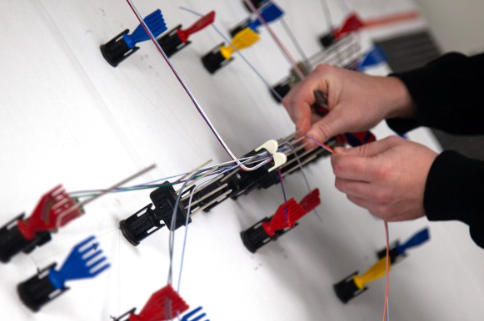
- Technicians route wires on a fixture or harness board according to the design drawing.
- Branches are grouped using tapes, sleeves, or loom tubing; then clips, ties, and conduits are added for protection and fixing.
- Special attention is given to bend radius, strain relief, and clearance from sharp edges or heat sources.
- Finished harnesses are tested for continuity, insulation resistance, and sometimes high-voltage withstand.
- Visual inspection checks labeling, orientation, and the quality of crimps and seals to avoid field failures.
- Many manufacturers follow standardized processes and traceability methods to meet automotive or industrial quality standards.
Wiring harnesses are present in almost every modern technology environment, even if users never see them.
- Passenger cars, trucks, buses, agricultural machinery, and construction equipment all rely on complex harness networks.
- Safety-critical systems such as airbags, ABS, and driver assistance systems depend on robust harnesses for reliable signal transmission.
- Harnesses connect sensors, actuators, drives, PLCs, and control panels in factories and infrastructure projects.
- They simplify commissioning and maintenance in large-scale installations by standardizing connections and routing.
- Cable and wiring harness assemblies connect servers, network switches, storage systems, and power distribution units.
- Custom harnesses support high-density racks while maintaining airflow and minimizing signal interference.
- TVs, audio equipment, medical analyzers, imaging systems, and smart home devices all use compact harnesses internally.
- These harnesses must provide high reliability in small spaces, often with strict safety and regulatory requirements.
Selecting the right wiring harness solution starts with understanding your technical requirements and operating environment.
- Electrical requirements: voltage, current, frequency, signal type, and grounding strategy.
- Environmental conditions: temperature range, humidity, vibration, fluids, dust, UV, and mechanical impact.
- Mechanical layout: available space, routing path, bend radius, and installation method.
- Regulatory and safety standards: industry-specific standards for insulation, flame retardancy, and electromagnetic compatibility.
- When your system layout is unique or space is extremely constrained.
- When you need special connectors, shielding, or protection for harsh environments.
- When you want to optimize assembly time and reduce wiring errors at your production line.
If you are a brand owner, wholesaler, or equipment manufacturer, working with an experienced wiring harness supplier ensures that every assembly matches your performance, cost, and lead-time targets. Professional manufacturers can support:
- OEM and ODM projects for USB, VGA, HDMI, DVI, SATA cables and related wiring harness assemblies.
- Custom design services, including connector selection, layout optimization, and prototyping for new products.
- Quality-controlled mass production with electrical testing, traceability, and logistics support for global markets.
A trusted partner helps you reduce wiring risks, shorten development cycles, and deliver more reliable products to your end users.
If your next project involves complex cable routing or multiple signal types, this is the ideal time to move from loose wiring to a professionally designed wiring harness solution. Share your drawings, connection list, or sample harness, and specify your electrical, mechanical, and environmental requirements. Contact us now to discuss a tailored wiring harness or cable assembly solution that will improve reliability, simplify installation, and support your long-term production growth.
Contact us to get more information!
The main purpose of a wiring harness is to connect and protect the electrical and signal paths between components while keeping the wiring organized and easy to install. It replaces multiple loose wires with a single, engineered assembly to improve safety, reliability, and efficiency.
A wiring harness groups multiple individual wires into a bundle with branches, while a cable assembly typically uses one or more pre-jacketed cables within an extra protective jacket. Harnesses offer more flexibility for branching, whereas cable assemblies are often used for fixed, point-to-point connections.
Wiring harnesses are widely used in automotive, industrial automation, consumer electronics, telecommunications, medical devices, and data centers. Any system that requires multiple electrical or data connections can benefit from a harness solution.
Common tests include continuity checks, insulation resistance measurements, and high-voltage tests to verify electrical safety and performance. Many manufacturers also conduct visual inspections, pull-force tests on crimps, and environmental checks where necessary.
You should choose a custom harness when standard off-the-shelf cables cannot meet your needs for layout, connector type, environmental resistance, or assembly speed. Custom solutions are especially valuable for OEM projects where consistent quality and efficient installation are critical.
1. https://en.wikipedia.org/wiki/Cable_harness
2. https://www.pcm-cable.com/oem-cables/
3. https://en.ctetechcorp.com/news/content?id=51
4. https://cloomtech.com/what-is-wiring-harness/
5. https://www.katocable.com/what-is-a-wiring-harness-a-comprehensive-guide
6. https://www.pcm-cable.com/info/what-is-a-automotive-wiring-harness-79472511.html
7. https://www.pcm-cable.com/info/what-is-the-purpose-of-the-wiring-harness-79472261.html


