


Views: 222 Author: Rebecca Publish Time: 2026-02-21 Origin: Site


Content Menu
● What Wiring Do LED Lights Need?
● Understanding LED Voltage and Wiring Basics
>> LED operating voltage: mains vs low voltage
>> Polarity and conductor roles
● Do You Need Special Wiring For LED Lights?
● Choosing the Right Cable Size (Gauge) for LED Lighting
>> Key factors for cable sizing
>> Typical wire sizes for LED applications
● Wiring Requirements by LED Type
>> Single‑color LED strips and modules
>> CCT (tunable white) LED lights
>> RGB, RGBW, and RGB+CCT LED strips
● How to Wire LED Lights Safely: Step‑by‑Step Overview
>> 1. Plan your layout and loads
>> 2. Prepare the power supply (driver)
>> 3. Make low‑voltage LED connections
>> 4. Test and secure the installation
● Voltage Drop and Brightness: Why Wire Size Matters
● Common Mistakes in LED Wiring (and How to Avoid Them)
● Wiring LED Lights With Controllers and Smart Systems
● Recommended Cables and Accessories for LED Wiring
● When to Consult a Professional Electrician
● Take the Next Step With Reliable Custom LED Wiring Solutions
● FAQs About Wiring for LED Lights
>> 1. What size cable do I need for 12 V LED strips?
>> 2. Can I use existing house wiring for new LED lights?
>> 3. Why are my LED strips dim at the far end?
>> 4. Do RGB and RGBW LED strips need special cables?
>> 5. Is it safe to wire LED lights myself?
LED lights are low‑voltage, high‑efficiency lighting devices, but they still depend on correctly selected cables, drivers, and terminations to operate safely and at full brightness. In most projects you will deal with a mix of mains‑voltage wiring (to feed the LED driver) and low‑voltage DC wiring (between the driver, controller, and LED fixtures or strips).
The right wiring for LED lighting always depends on three core factors: voltage, power (wattage), and distance (cable run length).

Most residential and commercial LEDs use built‑in drivers and connect directly to 110–240 V AC, so you use standard building cable for those circuits. Many LED strips, cabinet lights, signage, and landscape lights operate at 12 V or 24 V DC and require an external LED driver, also called a power supply.
Low‑voltage LEDs are safer to handle but more sensitive to voltage drop along the wire, which directly affects brightness. For low‑voltage systems, the wiring between the driver and the LEDs is just as critical as the mains feed to the driver.
On the low‑voltage DC side, LED wiring is polarized:
- Positive conductor: often marked “+”, red, or brown.
- Negative conductor: often marked “-”, black or blue.
- Protective earth (when required on the AC side): green‑yellow.
Reversing polarity on strips or modules can prevent them from lighting or even damage the product, so always match “+” to “+” and “-” to “-” at every connection point.
In most houses and commercial buildings, you do not need to rewire to use LED lamps in existing fixtures. Standard copper wiring used for halogen or incandescent circuits is generally suitable, as long as it meets the current and protection requirements of the circuit.
What you typically need is special attention, rather than “special” wire:
- Ensure existing wiring is in good condition and sized correctly for the circuit amperage.
- Add appropriate LED drivers, transformers, or power supplies where low‑voltage LED systems are used.
- Use multi‑core control cables for RGB, RGBW, and RGB+CCT strips and smart systems where multiple channels are controlled separately.
Selecting the correct cable size is one of the most important decisions for any LED installation.
When choosing cable gauge, consider:
- Total power (W) of the LEDs on the circuit.
- System voltage (12 V, 24 V, 120 V, 230 V, etc.).
- Run length between the driver and the furthest LED.
- Acceptable voltage drop (commonly kept under 3–5 percent for LED strips).
Higher current and longer runs require thicker cables (lower AWG number) to avoid overheating and excessive voltage drop.
The table below summarizes typical ranges often used in LED projects. Always check local codes and manufacturer data.
| Application scenario | Typical system | Typical wire size (AWG) | Notes |
|---|---|---|---|
| Short low‑power 12 V LED strips (under ~20 ft) | 12 V DC | 18–16 AWG | Suitable for lower currents over short distances. |
| Medium 12/24 V runs or higher wattage strips | 12–24 V DC | 16–14 AWG | Helps reduce voltage drop and heat. |
| High‑power strips or long runs | 12–24 V DC | 14–12 AWG or thicker | Recommended for 200–300 W systems and long cables. |
| General light circuits on 15 A breaker | 120–230 V AC | 14 AWG | Common for fixed lighting circuits. |
| Heavier‑duty 20 A circuits | 120–230 V AC | 12 AWG | Used in kitchens, outdoor, or high‑load circuits. |
For most residential low‑voltage LED setups, 16–18 AWG is frequently sufficient at short distances, while 14–12 AWG is preferred for longer or higher‑power runs.
Different LED products require different wiring structures.
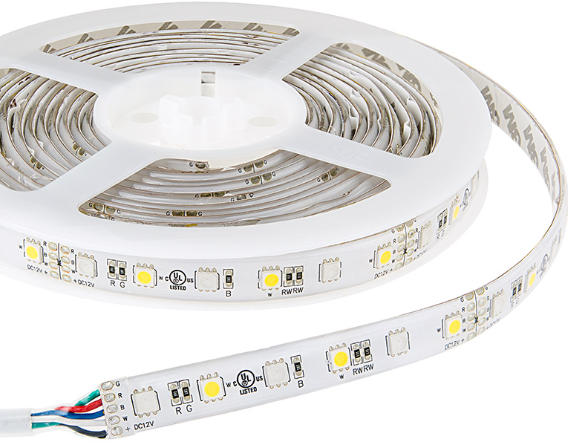
Single‑color LED strips have only two conductors: positive and negative.
- Wiring: “+” (positive) from driver to strip “+”, “-” (negative) from driver to strip “-”.
- Good practice: keep total strip power under about 80 percent of the driver's rated power to avoid overload.
- For long runs, use power injection from both ends or multiple feed points to keep brightness even.
CCT LEDs combine warm and cool white chips that need separate control channels.
Common configurations include:
- Two‑pole CCT: polarity switching method, less common today.
- Three‑pole CCT (most common):
- Shared positive (“+”)
- Separate negative lines for cool white (CW) and warm white (WW)
- Requires a three‑core cable between controller or driver and the light.
Multi‑color LED strips use multiple channels and need multi‑core cables.
Typical wiring patterns:
- RGB: shared “+” and “-R”, “-G”, “-B” → 4‑core cable.
- RGBW: shared “+” and “-R”, “-G”, “-B”, “-W” → 5‑core cable.
- RGB+CCT: shared “+”, “-R”, “-G”, “-B”, plus warm and cool white channels → usually 6‑core cable.
These systems usually connect LED strips to a controller or receiver first, then from the controller to the power supply.
The exact process varies by product, but most DIY LED strip installations follow a similar structure.
1. Map all LED strips, bars, downlights, or modules.
2. Add up total wattage on each run.
3. Select a driver whose power rating is at least 20 percent higher than the total load, using the 80 percent rule.
4. Choose cable gauge based on current and cable length, using a wire gauge chart if available.
- Identify AC input and DC output terminals on the driver.
- AC input: connect to mains using appropriate cable and a plug, spur, or junction box, respecting live, neutral, and earth color codes.
- DC output: typically marked “+V” and “-V” for positive and negative.
Always disconnect the mains before making any connections.
- Strip insulation from the low‑voltage cable ends.
- Connect driver positive to LED strip “+” and driver negative to LED strip “-”.
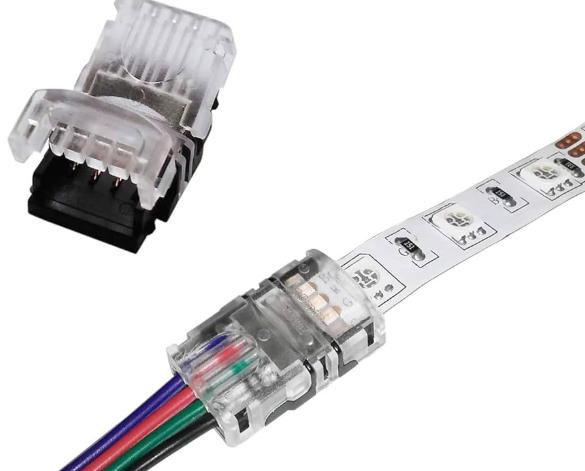
- For RGB, RGBW, and RGB+CCT, connect each channel to the matching terminal on the controller as specified by the manufacturer.
- Use soldered joints, crimp connectors, or quality terminals, avoiding loose or twisted‑only joints that can heat up and fail.
- Re‑energize the circuit and verify that all LEDs light evenly.
- If brightness is low or uneven, check for polarity errors, under‑sized cable, or excessive run length.
- Mount strips, drivers, and accessories in well‑ventilated locations and protect connections with suitable enclosures or junction boxes where needed.
Low‑voltage LED circuits are especially vulnerable to voltage drop along the cable.
As current flows through long, thin wires, some voltage is lost as heat, leaving less voltage available at the LEDs. This can cause visible dimming at the far end of long runs and may affect color consistency on strips.
Using thicker wires (lower AWG) and limiting run lengths dramatically reduces this effect. Many installers aim for under 3–5 percent voltage drop on LED runs for consistent brightness. For high‑power 12–24 V strip circuits, for example 200–300 W, wire sizes around AWG 14–12 or even 10 are commonly recommended to keep voltage drop under control.
Avoid these frequent problems when wiring LED lights:
- Using wire that is too thin for the run length and load, causing overheating or dim LEDs.
- Ignoring polarity, especially on strips and modules, leading to non‑working or damaged LEDs.
- Overloading drivers by connecting more wattage than specified.
- Mixing different LED types or voltages on the same driver or circuit.
- Hiding drivers in sealed, unventilated cavities where heat builds up.
Good practice includes correct sizing, clean terminations, adequate ventilation, and clear labeling of drivers and circuits for future maintenance.
Modern LED projects often integrate dimmers, remote receivers, or smart home gateways.
A typical structure is:
- Mains AC → LED driver → Controller or receiver → LED strips or fixtures.
On the low‑voltage side, multi‑core cables carry both power and control channels. Data‑driven systems, such as addressable strips, require dedicated data, clock, power, and ground conductors wired in the direction indicated on the strip.
It is important to follow the manufacturer's wiring diagram for each control system and to ensure that cables used for data and control are appropriate for the required signal integrity and distance.
High‑quality cables and accessories significantly improve reliability in LED systems.
For LED installations, it is advisable to consider:
- Flexible multi‑core cables for RGB, RGBW, and RGB+CCT strips and control lines.
- Shielded cables where data or control signals run long distances near noisy power lines.
- Pre‑terminated extension leads for quick plug‑and‑play installs in cabinets, signage, or displays.
- Water‑resistant or outdoor‑rated cables and connectors for garden and facade lighting.
A professional cabling partner that specializes in signal and power cable assemblies can also provide custom LED wiring harnesses tailored to your exact connector, length, and gauge requirements. This simplifies installation and improves consistency across projects.
Even though many LED projects look simple, incorrect mains wiring can be dangerous.
You should involve a licensed electrician when:
- Connecting LED drivers directly to fixed building wiring or distribution boards.
- Upgrading or extending existing 120–230 V circuits.
- Working in wet areas, outdoors, or commercial sites with specific safety regulations.
- You are unsure about circuit loading, protection devices, or local code requirements.
For low‑voltage wiring and plug‑in LED kits, experienced installers or integrators may handle most tasks, but mains connections and protection should always comply with local laws.
If you are planning a new LED lighting project or upgrading existing systems, choosing the right cable type, gauge, and connection method will directly influence safety, brightness, and long‑term reliability. As a professional manufacturer of USB, VGA, HDMI, DVI, SATA cables and cable accessories, OTECHKABEL can also support custom low‑voltage LED wiring assemblies that match your voltage, power, connector, and length requirements.
Tell us your LED system specifications, layout, and required interfaces, and our team will help you design and produce tailored cable assemblies that simplify installation and improve performance in your lighting projects. Contact us today to discuss your OEM or ODM LED wiring needs and get a customized cable solution for your next installation.
Contact us to get more information!
For short runs up to roughly 20 feet and modest power, 18–16 AWG is usually adequate. Longer or higher‑power runs often benefit from 14–12 AWG to limit voltage drop and heating. Always confirm with a wire gauge chart and the LED manufacturer's recommendations.
In most cases yes. Standard copper wiring used for incandescent or halogen circuits is fine for LED fixtures, provided it is in good condition, correctly sized for the circuit, and adequately protected by breakers or fuses. Any changes to fixed wiring should follow local regulations.
This is often caused by voltage drop from using thin cables or very long runs. You can improve performance by using thicker wire, shortening individual runs, adding power injection points, or increasing system voltage where compatible products are available.
They need multi‑core cables with one conductor for each color channel plus a shared positive conductor, and sometimes additional white or CCT channels. Depending on the strip type, this usually means 4‑core, 5‑core, or 6‑core cables to carry all channels safely and cleanly.
Low‑voltage DC wiring is often suitable for competent DIY users who follow instructions carefully. Any work involving mains wiring, distribution boards, or regulated environments should be handled by a qualified electrician to ensure safety and compliance with local codes.
1. https://www.pcm-cable.com/news/what-wiring-is-required-for-led-lights-69614413.html
2. https://www.pcm-cable.com/news/do-you-need-special-wiring-for-led-lights-69614588.html
3. https://www.pcm-cable.com/info/do-you-need-special-wiring-for-led-lights-85499080.html
4. https://ledstore.pro/page/installation-of-led-lights/cable-selection
5. https://www.lightsupplier.co.uk/blogs/lighting/how-to-connect-led-strip-lights-to-mains-in-the-uk
6. https://www.downlights.co.uk/how-to-connect-led-strip-lights-to-mains-a-step-by-step-guide.html
7. https://www.lensblx.com/what-size-cable-for-led-lighting.html
8. https://www.vertex-light.com/article/what-size-wire-should-i-use-my-led-recessed-downlight.html
9. https://www.signliteled.com/a-complete-guide-on-how-to-wire-led-strip-lights/
10. https://glledus.com/blogs/news/led-wire-gauge-selection-and-voltage-drop-calculation-for-12v-and-24v-led-strip-circuits


