


Views: 222 Author: Otechkabel Publish Time: 2026-05-25 Origin: Site


As someone who has spent years working with structured cabling and OEM production for network and communication cables, I often hear one question from installers, IT managers, and even DIY users: "Is Cat5 the same as phone cable?" [fiber-optic-transceiver-module]
The short answer is no—Cat5 Ethernet cable and traditional telephone cable are designed to different standards, use different connectors, and are built for very different speeds and applications. But the more useful answer is *when* you can use Cat5 for phone, *why* you shouldn't use phone cable for data, and *how* to choose the right cable for your next project. [firewall]
Below is an expert, practical guide written from the combined perspective of a network cabling engineer and an OEM cable manufacturer serving global brands and distributors.
Category 5 (Cat5) is a standardized unshielded twisted pair (UTP) cable originally designed for Ethernet and other high‑speed data networks. [firewall]
- It contains 4 twisted pairs (8 conductors total) made of copper. [fiber-optic-transceiver-module]
- The pairs have a specific twist rate per inch to reduce crosstalk and electromagnetic interference. [forums.moneysavingexpert]
- Classic Cat5 supports up to 100 Mbps networks, while its enhanced successor Cat5e is widely used for up to 1 Gbps. [firewall]
Cat5/Cat5e has largely been replaced in new installations by Cat6, but it is still very common in existing buildings and remains fully valid for many small office/home office networks. [firewall]
Typical Cat5/Cat5e applications:
- Office and home Ethernet LAN wiring. [forums.moneysavingexpert]
- Connecting PCs, switches, routers, access points. [fiber-optic-transceiver-module]
- Carrying VoIP phone traffic over data networks. [dlaycable]
When most people say "phone cable", they are talking about the flat or round cable used for analog telephones and DSL connections, typically terminated with RJ11 connectors. [fiber-optic-transceiver-module]
- It usually has 2 or 4 conductors (1 or 2 pairs), often with looser construction and fewer twists. [gamedev]
- It is optimized for voice frequency and relatively low‑bandwidth data like DSL, not for modern Ethernet speeds. [fiber-optic-transceiver-module]
- Connectors are smaller RJ11 or similar, which have fewer contacts than RJ45. [fiber-optic-transceiver-module]
Typical phone cable applications:
- Analog PSTN home telephone lines. [fiber-optic-transceiver-module]
- Basic PBX internal extensions (legacy systems).
- DSL connections from wall jack to modem. [fiber-optic-transceiver-module]

From an engineering and procurement perspective, Cat5 network cable and phone cable differ in construction, connectors, performance, and use cases. [firewall]
- Cat5 / Ethernet cable:
- Round, thicker jacket, typically contains 4 twisted pairs (8 wires). [fiber-optic-transceiver-module]
- Higher manufacturing standard, with tightly controlled twist rates to minimize crosstalk. [gamedev]
- Phone cable:
- Often narrower and sometimes flat, with fewer conductors (commonly 2 or 4). [fiber-optic-transceiver-module]
- Fewer twists per foot, which means more susceptibility to interference and lower usable bandwidth. [gamedev]
This is why Cat5 is "overkill" for simple voice lines but essential for high‑speed data. [firewall]
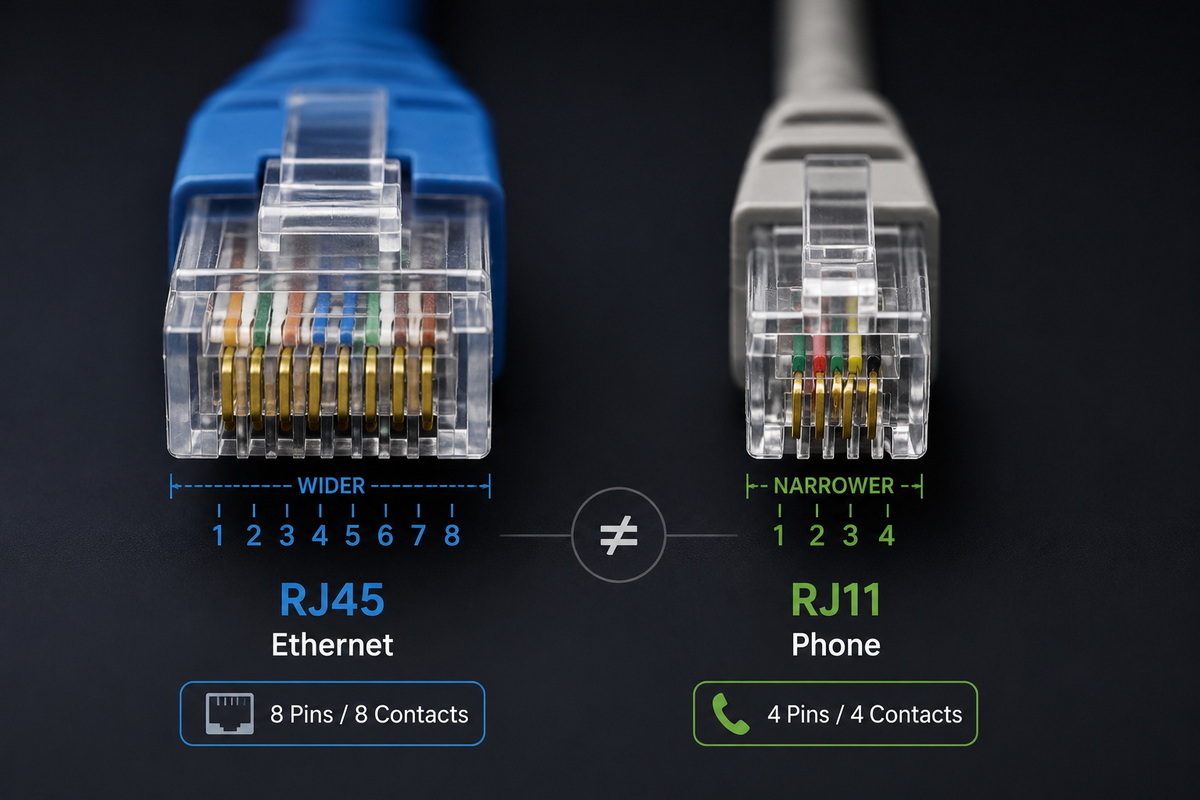
- Cat5 network cables are terminated with RJ45 connectors, which have 8 pins to accommodate 8 conductors. [fiber-optic-transceiver-module]
- Phone cables typically use RJ11 connectors, which have 4 or 6 positions, but usually only 2 or 4 wires are actually used. [fiber-optic-transceiver-module]
Result:
- An RJ11 plug fits mechanically into an RJ45 jack, but this is not recommended for professional installations because it may stress or misalign contacts.
- The jack and pin count limit the maximum bandwidth that can realistically be supported. [fiber-optic-transceiver-module]
- Cat5/Cat5e:
- Designed for Ethernet and can support up to 100 Mbps (Cat5) and 1 Gbps (Cat5e) over 100 meters when properly installed. [gamedev]
- Traditional phone cable:
- Adequate for voice and low‑bandwidth signaling, but not suitable for reliable 100 Mbps or 1 Gbps Ethernet. [gamedev]
As one networking reference notes, using phone‑grade cable for Ethernet is a "false economy" because it cannot deliver the required performance and reliability for modern networks. [forums.moneysavingexpert]
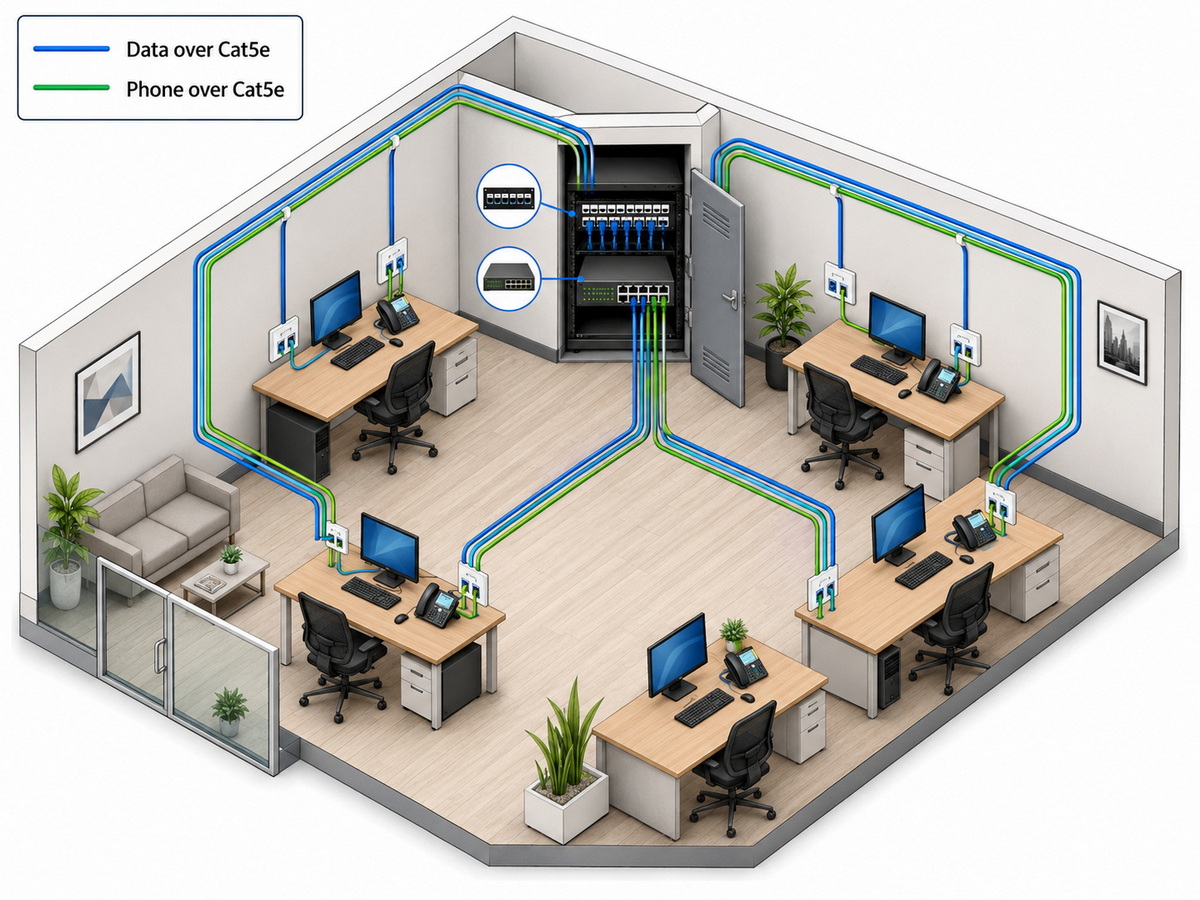
This is where things get interesting. In many real‑world installations, Cat5 is intentionally used for both phone and data. [reddit]
- For modern VoIP phones, the phone itself is actually an Ethernet device, so you *must* use Cat5, Cat5e, or Cat6 to connect it to the network. [dlaycable]
- For legacy analog phones, Cat5/Cat5e can still be used because voice frequency doesn't require high bandwidth—only a few conductors are necessary. [forums.moneysavingexpert]
- Some installers run a single Cat5 cable and split pairs to carry both Ethernet and analog phone on different pairs, though this is no longer considered best practice in new installations. [youtube]
- Standardization: Using Cat5e or Cat6 everywhere simplifies inventory and maintenance. [reddit]
- Future‑proofing: Even if a run is used for phone today, it can be repurposed for data tomorrow without pulling new cable. [firewall]
As a manufacturer, we see many commercial projects where all low‑voltage cabling (Ethernet, phone, control) is done with Cat5e or Cat6 to keep the building ready for upgrades.
From an engineering standpoint, the answer is no for professional networks, and "only in very limited cases" for hobby experiments. [forums.moneysavingexpert]
- Phone cable doesn't meet Cat5 specifications for twists per meter, crosstalk, and attenuation, so it cannot reliably support 100 Mbps or higher Ethernet. [gamedev]
- At best, some older phone‑grade twisted pair (like Cat3) can carry 10 Mbps Ethernet over short distances, but this is obsolete for modern standards. [gamedev]
For any serious business, industrial, or commercial deployment, do not design Ethernet runs based on phone cable. The savings in cable cost are tiny compared to the potential cost of downtime and troubleshooting.
| Feature | Cat5 / Cat5e Cable | Traditional Phone Cable |
|---|---|---|
| Main purpose | Ethernet and data networks firewall | Analog phone, DSL fiber-optic-transceiver-module |
| Number of conductors | 8 wires (4 twisted pairs) firewall | 2–4 wires (1–2 pairs) fiber-optic-transceiver-module |
| Typical connector | RJ45, 8 pins fiber-optic-transceiver-module | RJ11, 2–4 active pins fiber-optic-transceiver-module |
| Cable shape | Round, thicker jacket fiber-optic-transceiver-module | Often flat or thinner round fiber-optic-transceiver-module |
| Max typical speed | 100 Mbps (Cat5), 1 Gbps (Cat5e) firewall | Voice, low‑speed data (DSL) fiber-optic-transceiver-module |
| Use for VoIP phones | Recommended dlaycable | Not applicable |
| Use for analog phones | Works very well forums.moneysavingexpert | Native use case fiber-optic-transceiver-module |
| Use for Ethernet | Native use case firewall | Not recommended firewall |
For a UX‑optimized article, this table can be placed near the top to give readers a fast, scannable overview of the differences.
Based on common questions from customers and integrators, here are a few practical scenarios:
1. New office renovation
- Best practice is to install Cat5e or Cat6 to every outlet and run both data and VoIP phones over Ethernet. [dlaycable]
- If analog lines are still required, they can be patched through Cat5e to wall plates.
2. Older building with phone wiring only
- You may be able to reuse some structured Cat3 for temporary low‑speed links (10 Mbps), but upgrading to Cat5e/Cat6 is strongly recommended for reliability and speed. [firewall]
3. Home user asking "can I plug my phone into a Cat5 run?"
- Yes, if the Cat5 is connected back to a voice distribution point using the appropriate pairs; the installer or technician must wire it correctly. [reddit]
In every case, the safest long‑term strategy is to standardize on Ethernet‑grade twisted pair (Cat5e or better) and treat phone cable as a legacy solution.
From a technical perspective, the number of twists per inch and pair separation are what allow Cat5/Cat5e to carry high‑frequency signals reliably. [gamedev]
- More twists per foot reduce electromagnetic interference between pairs and from external sources. [firewall]
- Category standards (Cat5, Cat5e, Cat6) define maximum segment length, attenuation, and crosstalk limits, which phone cable does not comply with. [en.wikipedia]
This is also why Cat6 introduces physical separators between pairs to further improve performance and support higher speeds and frequencies. [en.wikipedia]
For procurement teams, this highlights that not all "4‑wire" or "8‑wire" cables are equivalent. The category rating is a real engineering standard, not just a marketing label.
As a Chinese OEM manufacturer supplying USB, VGA, HDMI, DVI, SATA and custom cable assemblies to international brands and distributors, we see the impact of cable choice at scale. [otechkabel.en.alibaba]
Here is how we advise our B2B customers:
- For structured cabling in commercial buildings:
- Standardize on Cat5e or Cat6 UTP for all network and phone outlets. [innovationvisual]
- This simplifies inventory, testing, and future upgrades.
- For telecom and PBX integrators:
- Use Cat5e/6 for any infrastructure that might carry VoIP, IP PBX, or future IP‑based services. [dlaycable]
- For OEM and private‑label brands:
- Make sure product descriptions clearly differentiate Ethernet patch cables from telephone cords, listing conductor count, connector type (RJ45 vs RJ11), and category rating. [sana-commerce]
By aligning your cable selection with actual use cases and future requirements, you reduce returns, support calls, and compatibility issues.
Even the best cable will underperform if installed incorrectly. Here are practical best practices:
- Respect maximum length
- For Cat5/Cat5e Ethernet, keep each run ≤ 100 meters including patch cords. [firewall]
- Avoid tight bends and kinks
- Sharp bends or crushing can change the cable geometry and increase crosstalk.
- Keep separation from power lines
- Run data and phone cables away from AC mains and high‑power cables when possible to reduce interference.
- Use quality connectors and terminations
- Terminate Cat5/Cat5e with proper RJ45 connectors or keystone jacks and follow T568A or T568B pinouts consistently. [firewall]
For phone lines carried over Cat5, your installer should clearly label pairs and cross‑connections in the patch panel to avoid confusion later.
If your infrastructure still relies heavily on legacy phone cable, you should consider upgrading when:
- You plan to roll out VoIP or IP‑PBX across the organization. [dlaycable]
- You experience frequent connection drops, noise, or low data rates on DSL.
- You need to support higher‑bandwidth applications like video conferencing, cloud services, or IP‑based building management.
Migrating to a structured Cat5e/Cat6 network not only improves performance today but also enables future technologies without re‑cabling the entire building. [innovationvisual]
If you are a brand owner, distributor, or system integrator planning a new cabling project or product line, it pays to involve an experienced OEM partner early.
- We can help you standardize SKUs for Ethernet and phone applications.
- You can customize cable length, jacket color, labeling, and packaging to match your brand and local standards.
- By aligning cable specs with your real‑world use cases, you reduce returns, technical support costs, and installation issues.
Get in touch with our technical sales team to discuss Cat5/Cat5e/Cat6, RJ45 patch cords, and telephone cable solutions tailored for your next project.
No. Cat5 is a category‑rated Ethernet cable with 4 twisted pairs designed for data networks, while typical phone cable uses fewer conductors and is optimized for voice and low‑bandwidth signals. [firewall]
Yes. Cat5 or Cat5e is commonly used for analog phones and VoIP phones, and many installers standardize on Ethernet‑grade cable for all low‑voltage runs. [reddit]
In professional environments, no. Phone cable usually does not meet Cat5 performance requirements, so it cannot reliably support 100 Mbps or 1 Gbps Ethernet. [gamedev]
RJ45 has 8 pins and is used for Ethernet cables like Cat5/Cat5e/Cat6, while RJ11 typically has 2–4 active contacts and is used for telephone cords. [fiber-optic-transceiver-module]
For most new installations, Cat5e is the minimum and Cat6 is widely recommended, as it offers better performance and future‑proofing for higher‑speed networks. [en.wikipedia]
1. "Google E‑E‑A‑T: What It Is & How It Affects SEO" – Semrush. [https://www.semrush.com/blog/eeat/] [semrush]
2. "Google's EEAT Guidelines – How To Remain Compliant" – Innovation Visual. [https://www.innovationvisual.com/knowledge-hub/resources/google-eeat-guidelines-how-to-remain-compliant] [innovationvisual]
3. "E‑E‑A‑T SEO Checklist" – GVN Marketing. [https://gvnmarketing.com/seo/eeat-seo-checklist/] [gvnmarketing]
4. "Ethernet cable vs phone cable: What's the Difference?" – Fiber‑Optic Transceiver Module. [https://www.fiber-optic-transceiver-module.com/differences-between-phone-network-cable.html] [fiber-optic-transceiver-module]
5. "Unshielded Twisted Pair (UTP) – CAT 1 to CAT5, 5e, CAT6 & CAT7" – Firewall.cx. [https://www.firewall.cx/networking/network-cabling/network-cabling-utp.html] [firewall]
6. User discussions on Cat5 vs telephone wire and crosstalk – MoneySavingExpert forum. [https://forums.moneysavingexpert.com/discussion/4228/ethernet-vs-telephone-cable] [forums.moneysavingexpert]
7. Technical Q&A on Cat5 and video/phone wiring – GameDev.net. [https://gamedev.net/forums/topic/155335-is-cat-5-suitable-for-video-signals/] [gamedev]
8. "Are Ethernet Cables Used for Phones Cat5" – DLAY Template Project. [https://dlaycable.com/are-ethernet-cables-used-for-phones-cat5/] [dlaycable]
9. "Reusing cat5e cables ran for phone lines for Ethernet ports?" – Reddit r/HomeNetworking. [https://www.reddit.com/r/HomeNetworking/comments/1476xkw/reusing_cat5e_cables_ran_for_phone_lines_for/] [reddit]
10. Company overview – Shenzhen Otechkabel Electronic Co., Ltd. [https://otechkabel.en.alibaba.com] [otechkabel.en.alibaba]


