


Views: 273 Author: Otechkabel Publish Time: 2026-07-06 Origin: Site


In network cabling, straight-through and crossover cables are often confused, but they serve different wiring purposes. Understanding the difference helps installers, buyers, and OEM customers choose the right cable for the right application, avoid troubleshooting errors, and specify products more accurately in procurement and manufacturing workflows. [techniciansolution]
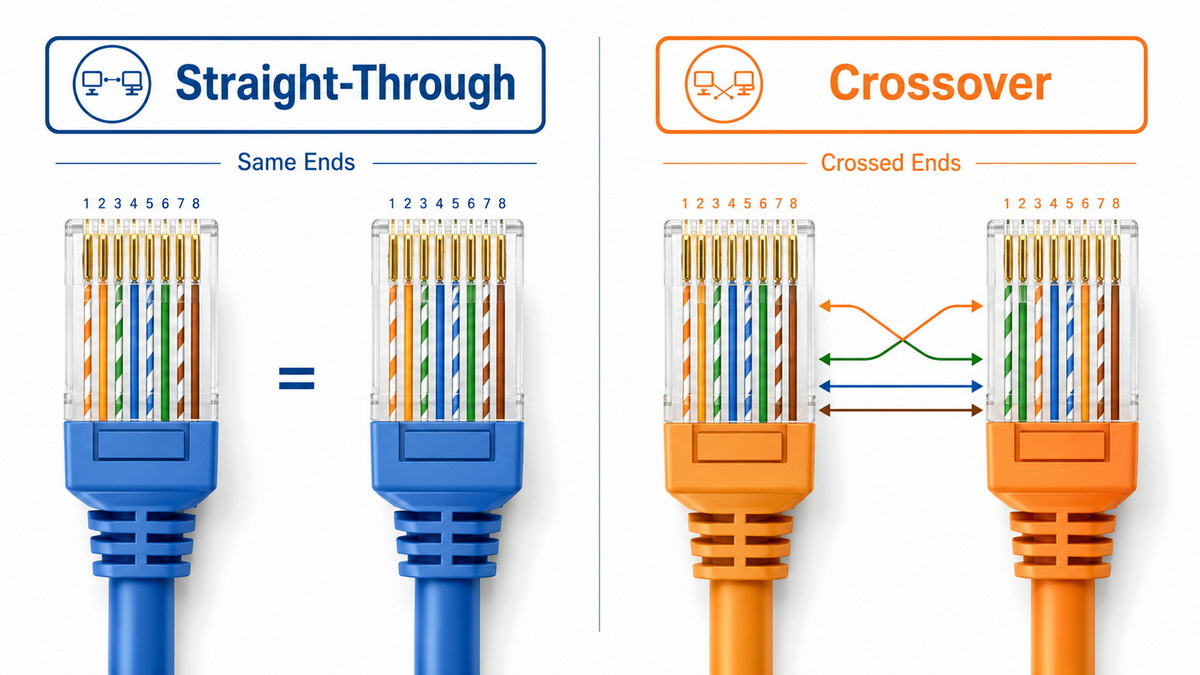
Even though many modern network devices support auto MDI/MDI-X, the wiring standard still matters for compatibility, quality control, and legacy installations. For manufacturers and B2B buyers, knowing the difference also improves product specification, labeling, and customer support accuracy. [developers.google]
A straight-through cable is an Ethernet cable in which both ends use the same wiring standard, typically T568A-to-T568A or T568B-to-T568B. In simple terms, pin 1 goes to pin 1, pin 2 goes to pin 2, and so on. [professormesser]
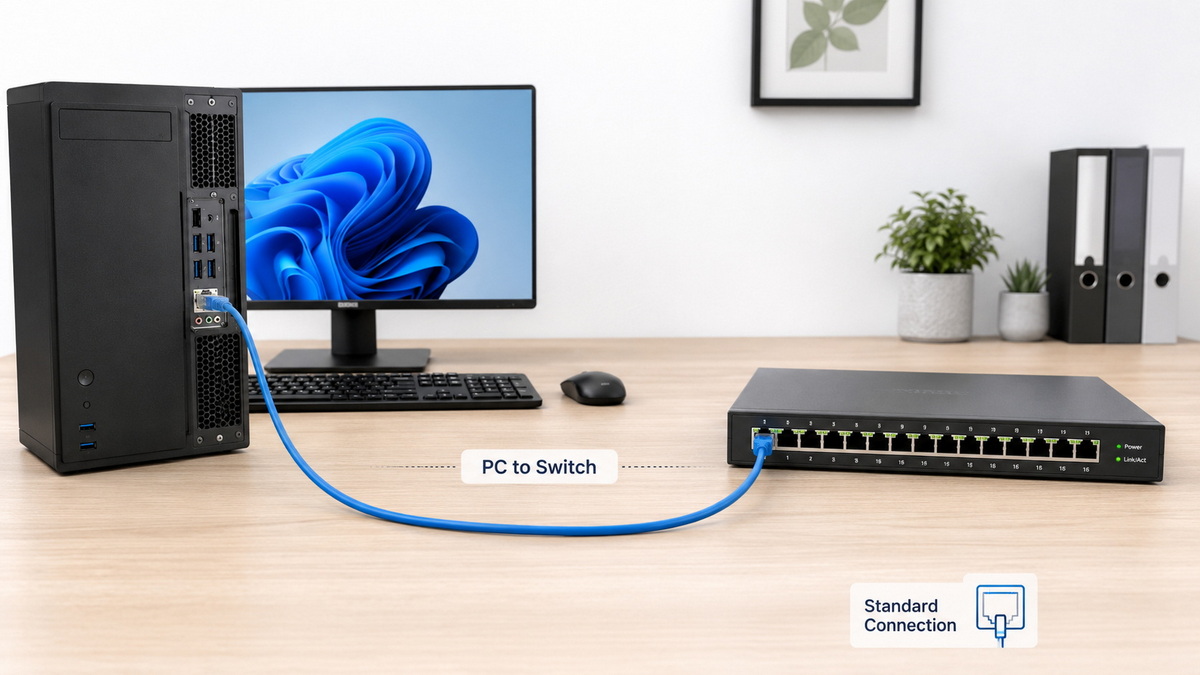
This type of cable is commonly used to connect different device types, such as a computer to a switch, router to a modem, or a workstation to a network outlet. It is the default choice in many structured cabling environments because it is simple, predictable, and easy to standardize across installations. [techniciansolution]
A crossover cable uses different wiring standards at each end, usually T568A on one side and T568B on the other. This creates a crossover of the transmit and receive pairs, traditionally by crossing pins 1 and 3, and pins 2 and 6. [gurusoftware]
Crossover cables were historically used to connect similar devices directly, such as computer-to-computer, switch-to-switch, or router-to-router connections without an intermediary device. In older networks, this cable type solved a real compatibility problem when two devices needed direct communication. [professormesser]
| Item | Straight-through cable | Crossover cable |
|---|---|---|
| Wiring at both ends | Same standard on both ends | Different standards on each end |
| Typical pin relationship | Pin 1 to 1, pin 2 to 2 | Transmit and receive pairs are crossed |
| Main use | Different device types | Same device types |
| Common examples | PC to switch, router to modem | PC to PC, switch to switch |
| Modern relevance | Very common | Less common, but still useful in some cases |
This distinction is easy to remember: straight-through for different devices, crossover for similar devices. That rule is still useful, especially in mixed installations, older systems, and OEM documentation. [techniciansolution]
Ethernet twisted-pair cabling is built around color-coded pairs and standardized pin assignments. The two most common wiring patterns are T568A and T568B, and the practical difference between them is the arrangement of the green and orange pairs. [professormesser]
From a manufacturing standpoint, both standards can be produced reliably as long as the assembly process, conductor sequence, and connector termination are controlled. For B2B customers, the key is not just whether the cable "works," but whether it is built consistently, labeled clearly, and tested properly. [sana-commerce]
- Connecting a computer to a switch.
- Connecting a router to a modem.
- Connecting a device to a wall outlet or patch panel.
- Building standard office, data room, or industrial network layouts.
- Connecting two computers directly.
- Connecting two switches in legacy environments.
- Connecting two routers directly when auto-negotiation is unavailable.
- Troubleshooting older equipment that does not support auto MDI/MDI-X.
For modern networks, many devices detect the signal direction automatically, so crossover cables are used less frequently than before. Still, they remain valuable in legacy systems, special applications, and certain lab or test environments. [techniciansolution]
From a cable manufacturer's perspective, the real issue is not only wiring type, but build quality and consistency. A poorly terminated cable can cause intermittent connection loss, packet errors, or performance degradation that looks like a device problem but is actually a cable problem. [sana-commerce]
That is why OEM buyers should evaluate not just the cable category and length, but also conductor material, connector plating, strain relief, shielding, and test results. In bulk production, small defects can scale into large customer complaints if quality control is weak. [linkgraph]
Before placing an OEM or wholesale order, confirm the following:
1. Cable type and application: straight-through or crossover.
2. Wiring standard: T568A, T568B, or mixed.
3. Conductor specification: copper or copper-clad aluminum.
4. Connector type: RJ45, shielded RJ45, or custom termination.
5. Shielding requirement: UTP, FTP, or S/FTP depending on the environment.
6. Testing requirement: continuity, wire map, and performance test.
7. Packaging and labeling: retail pack, bulk pack, or custom OEM branding.
This checklist helps reduce rework, avoid returns, and improve customer satisfaction across distribution and private-label programs. [developers.google]
Many cable buyers make the mistake of choosing by appearance alone. Straight-through and crossover cables may look nearly identical from the outside, so the difference must be verified by wire map, label, or testing equipment. [professormesser]
Another common error is assuming that a cable type alone guarantees performance. In reality, network stability also depends on termination quality, cable category, shielding, and installation environment. That is especially important in manufacturing, warehousing, and industrial settings where cable runs may face electrical noise or physical stress. [linkgraph]
A professional cable supplier should verify the assembly through a simple but strict process:
- Check pinout against the required standard.
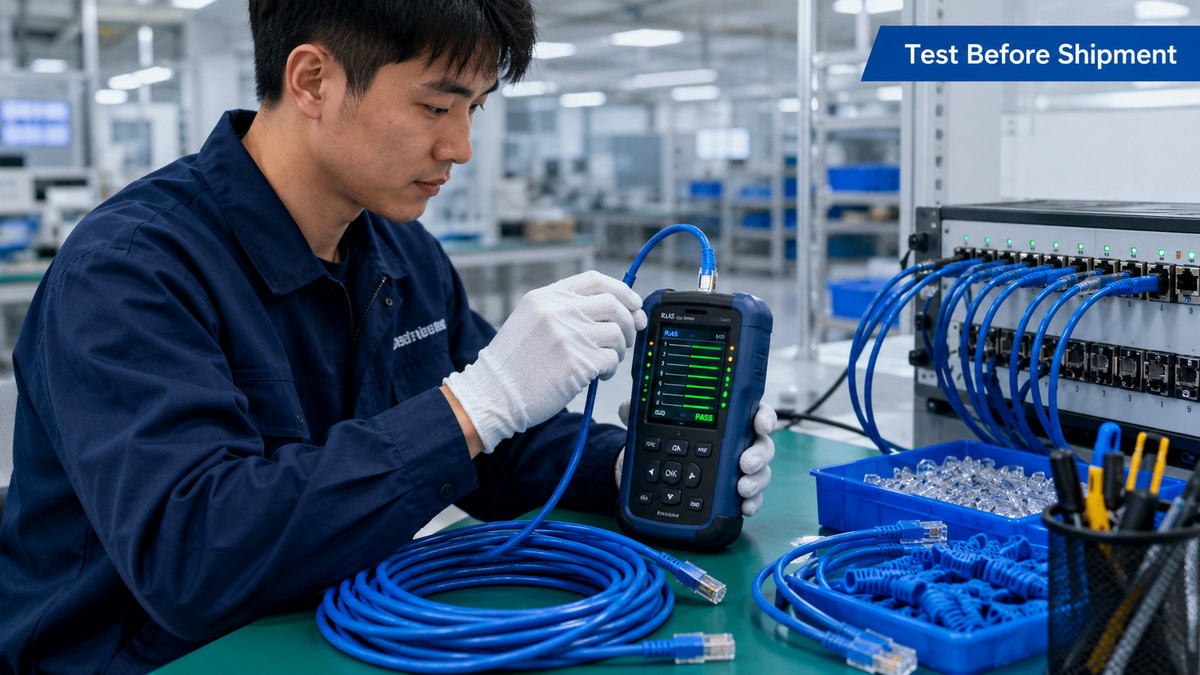
- Test continuity and pair mapping.
- Inspect crimp quality and connector fit.
- Confirm labeling and packaging accuracy.
- Run a final visual inspection for jacket, strain relief, and connector damage.
This kind of process supports trust, lowers failure rates, and strengthens the supplier's reputation with overseas buyers and OEM clients. [sana-commerce]
For OEM and private-label customers, cable selection affects more than connectivity. It affects product positioning, support burden, lead time, and customer satisfaction. A supplier that understands both the technical standard and the business use case can deliver more reliable results for brand owners and wholesalers. [linkgraph]
If your project involves USB, VGA, HDMI, DVI, SATA, or network cable production, the best supplier is not only a factory that can assemble cables, but also a partner that can help define the correct specification, verify the wiring, and maintain consistent quality at scale.
The difference between straight-through and crossover cables comes down to wiring, application, and compatibility. Straight-through cables are the standard choice for connecting different device types, while crossover cables are mainly used for direct connections between similar devices or legacy equipment. [techniciansolution]
For modern B2B buyers, the real advantage is choosing a supplier that can produce the correct wiring standard, test every batch, and support OEM requirements with clear documentation and reliable quality control. [developers.google]
A straight-through cable uses the same wiring standard on both ends, while a crossover cable uses different standards on each end to cross transmit and receive pairs. [professormesser]
In many modern devices, yes, because auto MDI/MDI-X may handle the connection automatically. However, older devices may still require the correct cable type. [professormesser]
Straight-through cables are more common today because most network setups use switches and routers in standard layouts, and many devices support automatic pair negotiation. [techniciansolution]
You can check the wire map by testing the cable, inspecting the printed label, or reviewing the manufacturer's specification sheet. The outside jacket often looks the same. [gurusoftware]
Yes, but mostly in legacy networks, direct device-to-device links, or specialized testing environments where automatic detection is unavailable or not desired. [professormesser]
1. Google Search Central. Creating helpful, reliable, people-first content. https://developers.google.com/search/docs/fundamentals/creating-helpful-content [developers.google]
2. Technician Solution. Straight Through Cables vs Crossover Cables: Key Difference. https://www.techniciansolution.com/2022/07/straight-through-cables-vs-crossover.html [techniciansolution]
3. Professor Messer. Straight-Through and Crossover Cables. https://www.professormesser.com/network-plus/n10-008/n10-008-video/straight-through-and-crossover-cables-n10-008/ [professormesser]
4. Guru Software. Decoding the Critical Differences Between Straight Through and Crossover Cables. https://www.gurusoftware.com/decoding-the-critical-differences-between-straight-through-and-crossover-cables/ [gurusoftware]
5. Sana Commerce. The complete guide to SEO for manufacturers. https://www.sana-commerce.com/blog/seo-for-manufacturers/ [sana-commerce]
6. Robert Siegers. SEO for Manufacturers. https://robertsiegers.com/en/seo-for-manufacturers [robertsiegers]
7. World SEO Agency. SEO for Cable & Wire Suppliers. https://www.worldseoagency.com/industries/seo-for-cable-suppliers/ [worldseoagency]


