


Views: 222 Author: Otechkabel Publish Time: 2026-06-30 Origin: Site


USB Power Delivery (USB PD) is the modern standard that lets USB cables and chargers deliver higher power, faster charging, and more flexible compatibility across phones, laptops, monitors, docking stations, and other devices. For brands, wholesalers, and OEM buyers, understanding USB PD cables, power profiles, and certification requirements is essential for choosing reliable products and avoiding costly compatibility problems. [usb]
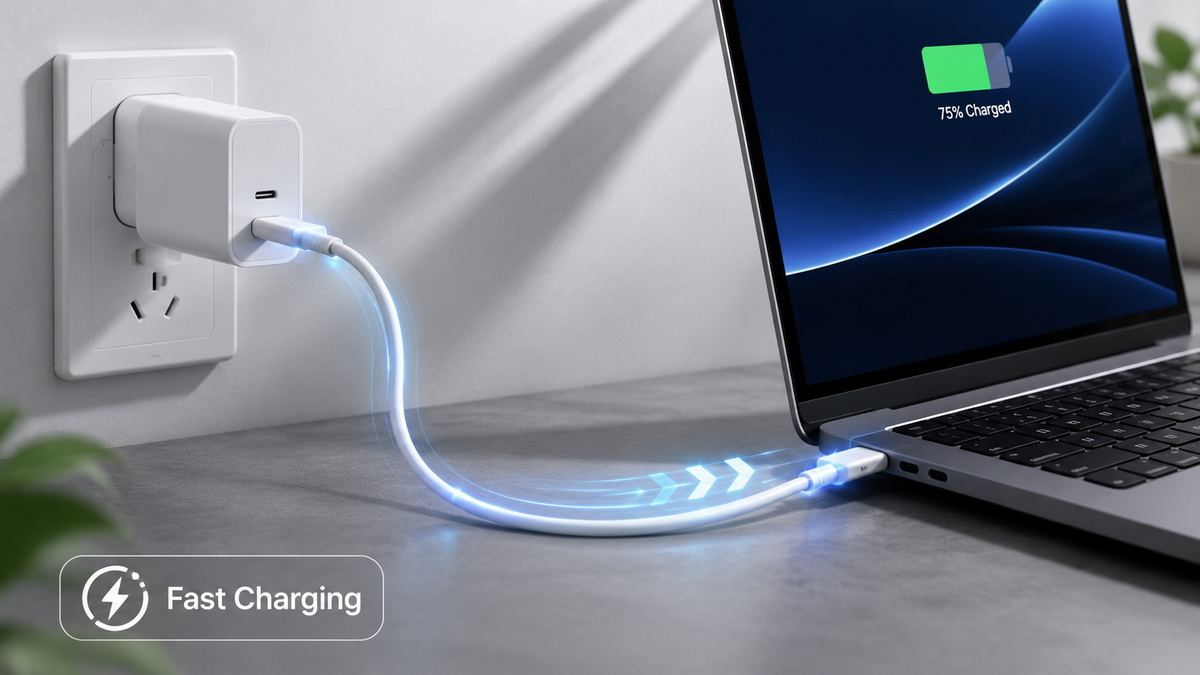
USB Power Delivery is a fast-charging and power-management specification developed to move more power through USB connections while still supporting data transfer. Compared with older USB charging methods, USB PD allows devices and chargers to negotiate power levels intelligently, which helps devices charge faster and more safely. [usb]
In practical terms, USB PD is not just "faster charging." It is a smart power negotiation system that can adapt to different devices and workloads. That is why the same USB-C ecosystem can support a smartphone, a tablet, a portable monitor, or even a thin-and-light laptop. [usb]
USB PD has become a core selling point in consumer electronics and B2B device design because users now expect one charger to work across multiple devices. This reduces clutter, improves convenience, and creates a more premium user experience. [usb]
For manufacturers and cable buyers, USB PD also affects product positioning. A cable that supports USB PD can be marketed as a higher-value accessory, especially when it is designed with the right current rating, connector quality, and certification path. [usb]
USB PD works through communication between the power source and the powered device. The charger and device first identify each other's capabilities, then agree on a safe voltage and current level. [usb]
This negotiation process is what makes USB PD more flexible than fixed-voltage legacy charging. Instead of forcing every device to accept the same output, USB PD matches power delivery to the device's actual needs. [usb]
1. A device connects to a USB PD charger through a compatible cable.
2. The charger and device exchange information about supported power levels.
3. Both sides select a profile that balances speed, safety, and compatibility.
4. Charging begins at the negotiated level.
This is one of the reasons USB PD is widely used in premium mobile devices and productivity hardware. [usb]
The main difference between USB PD and standard USB charging is intelligence and power capacity. Standard USB charging is usually more limited in output and less flexible across device types, while USB PD is designed to negotiate higher, more efficient power delivery. [usb]
| Feature | Standard USB Charging | USB Power Delivery |
|---|---|---|
| Power negotiation | Limited | Advanced |
| Output flexibility | Low | High |
| Device compatibility | Basic | Broad |
| Typical use cases | Simple accessories | Phones, tablets, laptops, docks |
| User experience | Slower, less adaptive | Faster, smarter charging |
For buyers, this distinction matters because the cable must match the charger and device ecosystem. A weak cable can become the bottleneck even when the charger supports high power. [usb]
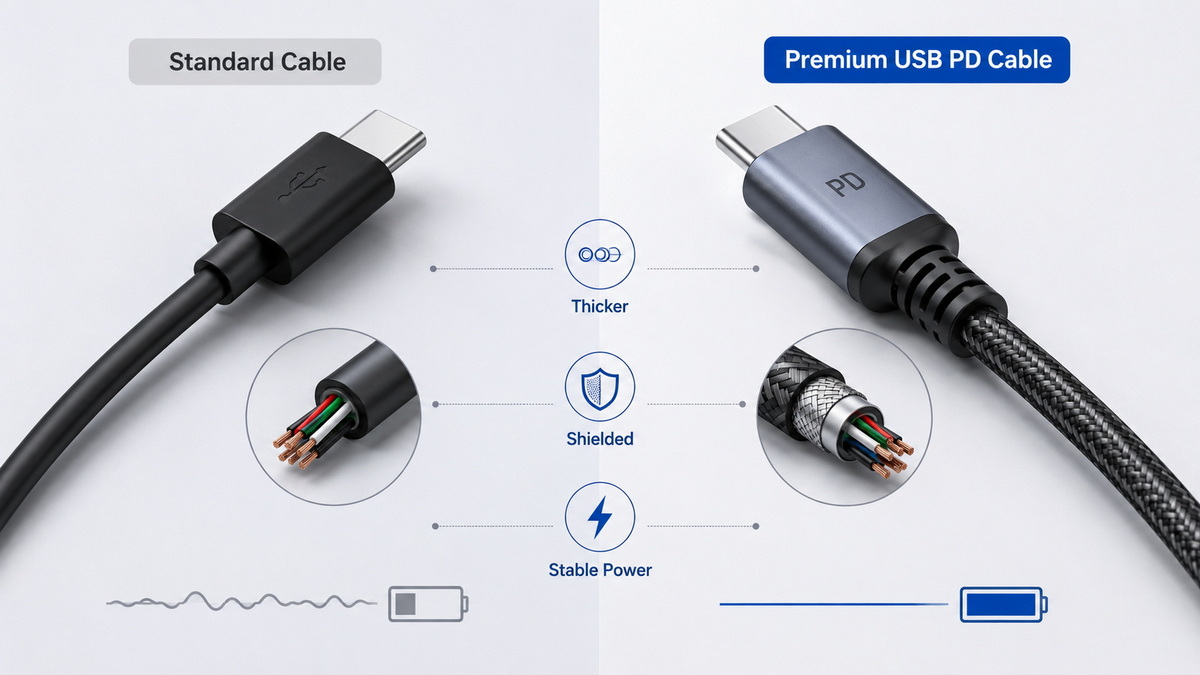
A USB PD cable is not just a physical connector. It is part of the power-delivery chain, and its build quality can directly affect charging speed, reliability, and safety. For OEM sourcing, the key is to match cable design to the target power level and the device category. [usb]
- Current rating, especially for higher-power devices.
- Connector type, such as USB-C to USB-C or USB-A to USB-C.
- Cable length, since longer cables may increase voltage drop.
- Build quality, including shielding, jacket material, and strain relief.
- Certification and testing, where applicable for the target market.
If your customers charge laptops or monitors, cable performance becomes even more important. In those cases, the cable should be designed for stable delivery under real-world conditions, not just lab scenarios.
USB PD is now used across a wide range of devices and environments. It is especially common in ecosystems where users want one cable or charger for multiple products. [usb]
- Smartphones and tablets.
- Ultrabooks and lightweight laptops.
- Portable displays and docking stations.
- Power banks with fast input/output support.
- Office and travel charging setups.
For OEM brands, this creates an opportunity to bundle cables with devices and improve the overall perceived value of the product line. It also reduces support complaints caused by underperforming accessories.
One of the biggest mistakes buyers make is focusing only on the charger and ignoring the cable. In real deployments, the cable often determines whether the customer actually gets the advertised charging performance. [usb]
Another common issue is mismatch between power expectations and product labeling. A cable may look similar to another cable on the outside, but the internal design, wire gauge, connector quality, and testing standard can be completely different. For B2B procurement, that difference can mean the gap between repeat business and returns.
This is where working with an experienced cable manufacturer matters. A supplier with OEM experience can help align the product design with your market, target devices, and branding requirements.
If you are sourcing USB PD cables for international brands or wholesale channels, a clear specification sheet saves time and avoids rework. It also improves communication between procurement, engineering, and sales teams. [jonjachura]
- Cable type and connector combination.
- Power target and supported charging use case.
- Length tolerance.
- Jacket material and color.
- Shielding and durability requirements.
- Branding or private-label needs.
- Testing and compliance expectations.
A good OEM brief should also define the end-user scenario. A cable intended for a travel accessory bundle may need different durability and flexibility characteristics than a cable intended for a desktop docking setup.

Before approving a USB PD cable for production, ask these questions:
1. Does the cable support the required power level?
2. Is it compatible with the intended devices?
3. Has the cable been tested under realistic usage conditions?
4. Does it meet the buyer's durability and branding needs?
5. Can the supplier provide stable OEM/ODM support?
This checklist helps reduce quality risk and keeps product claims aligned with real performance. It also makes your sales messaging easier, because you can confidently explain what the cable is designed to do.
USB PD continues to grow in importance because the market is moving toward fewer chargers, more universal accessories, and higher-power mobile computing. The trend is especially strong in USB-C ecosystems where users expect one cable to serve multiple roles across devices. [usb]
For cable manufacturers, this means demand is shifting away from "generic charging cables" and toward better-engineered products with clearer use-case positioning. In other words, the winning products are the ones that combine compliance, durability, and strong commercial packaging.
For brand owners, USB PD is more than a technical feature. It is part of the product story, the customer experience, and the quality perception of the entire brand. [developers.google]
If your accessories underperform, customers often blame the brand rather than the cable alone. That is why OEM cable selection should be treated as a strategic decision, not a commodity purchase.
USB Power Delivery has become the standard that connects faster charging with smarter device compatibility. For OEM buyers and brand owners, the real opportunity is not just to follow the trend, but to source USB PD cables that are engineered for performance, validated for quality, and aligned with the customer experience. [usb]
If your goal is to build a stronger accessory line, the next step is to pair the right cable specification with the right market positioning and supplier capability.
USB Power Delivery is a charging specification that allows devices and chargers to negotiate higher, smarter power levels over USB connections. [usb]
No. USB-C is a connector type, while USB PD is a power-delivery standard that can run over compatible USB-C connections. [usb]
No. A cable must be designed and rated appropriately for the required power and use case. [usb]
Cable quality affects charging stability, power loss, durability, and real-world performance. [usb]
Yes. USB PD is commonly used for many modern laptops, especially thin-and-light models and docking setups. [usb]
1. USB-IF. "USB Charger (USB Power Delivery)." [https://www.usb.org/usb-charger-pd] [usb]
2. Shenzhen Otechkabel Electronic Co., Ltd. "About Us." [https://www.cnotechkabel.com/about-us] [cnotechkabel]
3. Jon Jachura. "Electrical Components Technical Writing Services." [https://jonjachura.com/services/electrical-components-technical-writing-services/] [jonjachura]
4. Google Search Central. "Creating helpful, reliable, people-first content." [https://developers.google.com/search/docs/fundamentals/creating-helpful-content] [developers.google]
5. QuickCreator. "E-E-A-T for Technical Content: 2025 Best Practice Guide." [https://quickcreator.io/blog/eeat-for-technical-content-2025-best-practice-guide/] [quickcreator]


