


Views: 255 Author: Otechkabel Publish Time: 2026-06-29 Origin: Site


RCA cables remain one of the most widely recognized analog connection standards in audio and video systems. Although modern digital interfaces have taken over many consumer and professional applications, RCA audio cables and RCA video cables are still essential in home entertainment, legacy equipment, CCTV systems, AV integration, and OEM cable assemblies.
For buyers, engineers, and sourcing teams, the real challenge is not identifying the connector shape. It is understanding signal type, application fit, shielding quality, and performance limits so the right cable is selected for the right system.
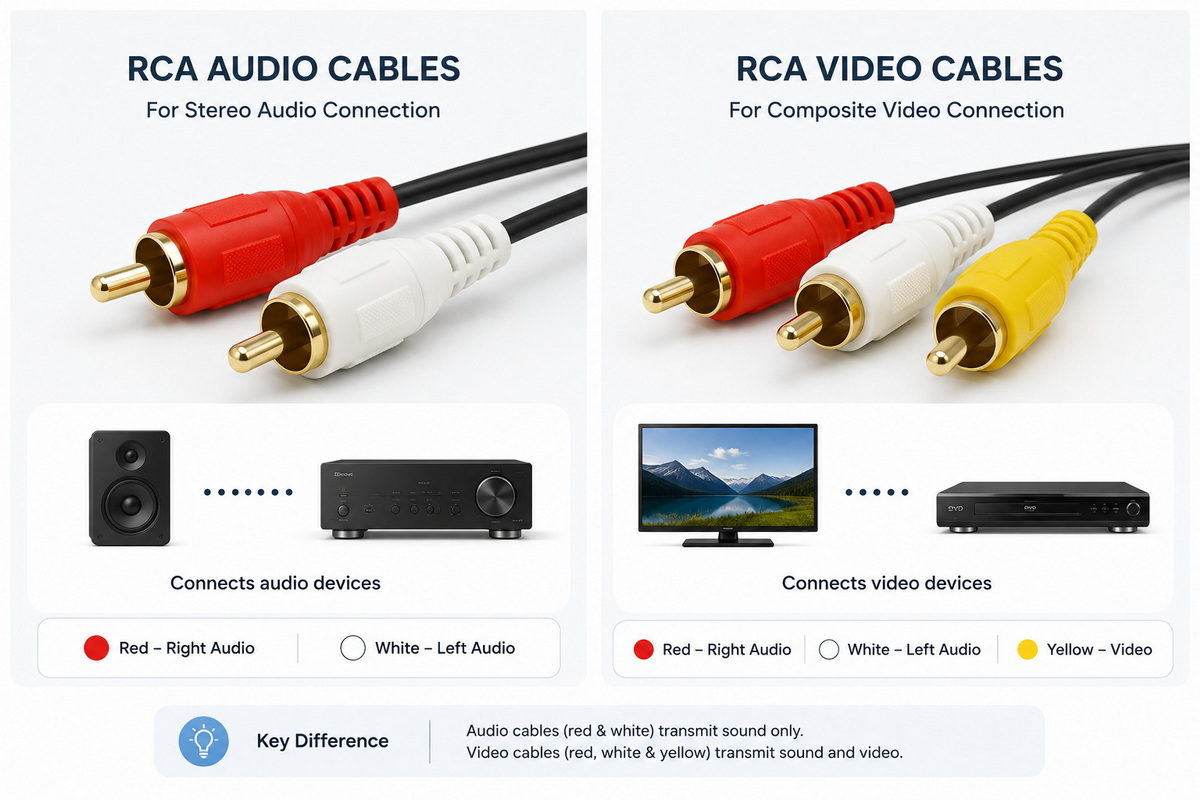
An RCA cable is a cable terminated with RCA connectors, also known as phono connectors. These connectors typically use a center pin for signal and an outer ring for ground, making them suitable for unbalanced analog transmission.
RCA cables are most commonly used for:
- Stereo audio signals.
- Composite video signals.
- Subwoofer connections.
- Legacy AV devices.
- Custom OEM cable assemblies.
Because the connector design is simple and reliable, RCA remains popular in mass production, repair markets, and compatibility-focused products.
The terms "audio cable" and "video cable" often describe the intended signal, not a completely different physical connector design. In many cases, the connectors look the same, but the cable construction, shielding, and color coding may differ.
| Cable Type | Typical Use | Common Color | Key Requirement |
|---|---|---|---|
| RCA audio cable | Left/right stereo audio | Red / White | Low noise, stable analog transmission |
| RCA video cable | Composite video | Yellow | Better shielding and signal integrity |
| RCA subwoofer cable | Low-frequency audio | Usually single RCA | Strong shielding, clean low-end delivery |
In practical use, the most important difference is application and performance expectation rather than connector appearance alone. For example, a cable that works fine for short audio runs may not be ideal for video because video signals are more sensitive to interference and attenuation.
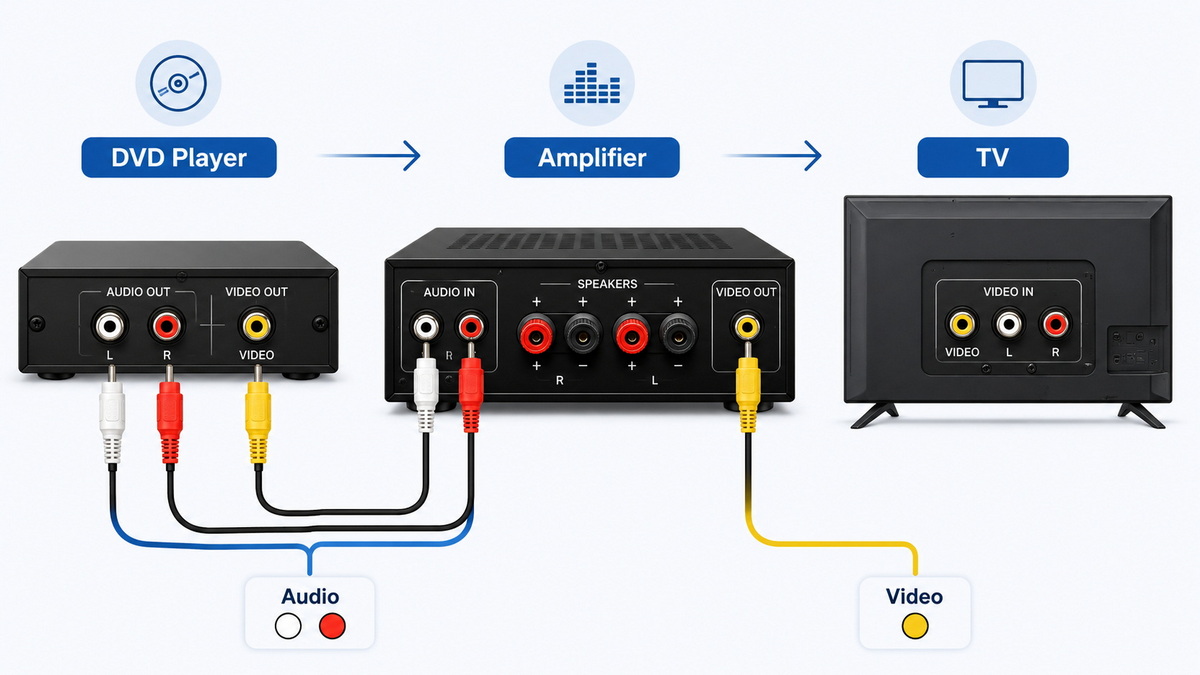
RCA audio cables carry analog line-level signals between devices such as DVD players, amplifiers, TVs, mixers, and speakers with RCA input/output ports. In a stereo setup, one cable carries the left channel and another carries the right channel.
Good RCA audio cables should offer:
- Strong shielding to reduce hum and interference.
- Tight connector fit for stable contact.
- Flexible jacket for easier routing.
- Durable strain relief to resist wear.
For OEM buyers, the real performance difference often comes from copper quality, shielding structure, plating, and manufacturing consistency rather than connector color alone.
RCA video cables are most commonly used for composite video transmission, where one yellow RCA connector carries the full video signal. This is still common in older televisions, surveillance equipment, retro game consoles, and AV conversion systems.
Because video signals can degrade more visibly than audio signals, RCA video cables need:
- Better shielding against electromagnetic noise.
- Controlled impedance where applicable.
- Consistent build quality.
- Reliable connector contact.
A poorly made video cable may cause ghosting, noise, color distortion, or unstable image quality. That is why cable construction matters more than the connector shape itself.
When choosing or manufacturing RCA cables, several technical details determine real-world performance.
High-purity copper generally supports better conductivity and signal stability. For cost-sensitive OEM projects, the cable specification should balance performance and price without compromising reliability.
Shielding helps protect low-level analog signals from external interference. Common shielding choices include foil, braid, or a combination of both. Better shielding is especially valuable in environments with power cables, machines, or dense AV routing.
The outer jacket affects flexibility, durability, and appearance. PVC is common, while more specialized jackets may be used for improved temperature resistance or premium positioning.
Gold-plated connectors can improve corrosion resistance and long-term contact quality, especially in humid or high-usage environments. However, plating should be matched to the actual use case, not treated as a universal upgrade.
A good connector housing and proper strain relief can significantly extend service life. For OEM and private-label products, these details are often what separate commodity products from professional-grade assemblies.
RCA cables are still a practical choice when a system needs simple analog connectivity. They are especially useful in older equipment, cost-sensitive products, and installations where compatibility matters more than advanced digital features.
Typical use cases include:
- Home audio systems.
- TV and DVD player connections.
- Retro gaming consoles.
- Car audio systems.
- Security and surveillance installations.
- Custom AV hardware.
If the device only supports analog I/O, RCA is often the most efficient and economical solution.
From a manufacturing and sourcing standpoint, the RCA cable market has shifted from pure consumer demand to specialized replacement, legacy support, and OEM customization. That means customers increasingly want cables that are not just functional, but also branded, application-specific, and consistent across production batches.
For suppliers, this creates an opportunity: instead of selling a generic cable, position RCA products as part of a broader solution—custom length, custom color, custom packaging, and stable quality control. Industrial SEO guidance also shows that buyers respond better to pages that answer technical questions clearly and present product specs in a structured format. [blog.saleslayer]
Use this checklist when sourcing RCA audio or video cables.
1. Confirm the signal type: audio, composite video, or subwoofer.
2. Check the device interface and connector count.
3. Match cable length to the installation distance.
4. Evaluate shielding if the cable will run near power sources.
5. Review conductor, plating, and jacket specifications.
6. Ask for OEM options if branding or packaging matters.
7. Test sample performance before mass production.
This simple process reduces return risk and helps buyers choose the right cable for the right application.
For brands, wholesalers, and manufacturers, RCA cables are rarely just a low-cost accessory. They are often part of a broader product ecosystem where customer satisfaction depends on fit, finish, and durability.
A strong OEM cable supplier should be able to provide:
- Stable material sourcing.
- Consistent production quality.
- Custom branding support.
- Flexible cable lengths and colors.
- Packaging tailored to retail or B2B channels.
In industrial content strategy, pages that combine technical accuracy with buyer-focused language tend to perform better because they match both search intent and commercial intent. [kunocreative]
As a cable manufacturer, our role is not only to produce cables, but to help brands and distributors turn product requirements into reliable finished goods. That includes material selection, cable structure recommendations, connector options, and production support for international markets.
For RCA-related projects, this can mean:
- Custom RCA audio cables.
- Custom RCA video cables.
- Multi-channel AV cable assemblies.
- Brand-specific packaging.
- Bulk production for wholesalers and OEM clients.
If your goal is to source cables that meet both market and technical expectations, product engineering and communication quality matter as much as price.
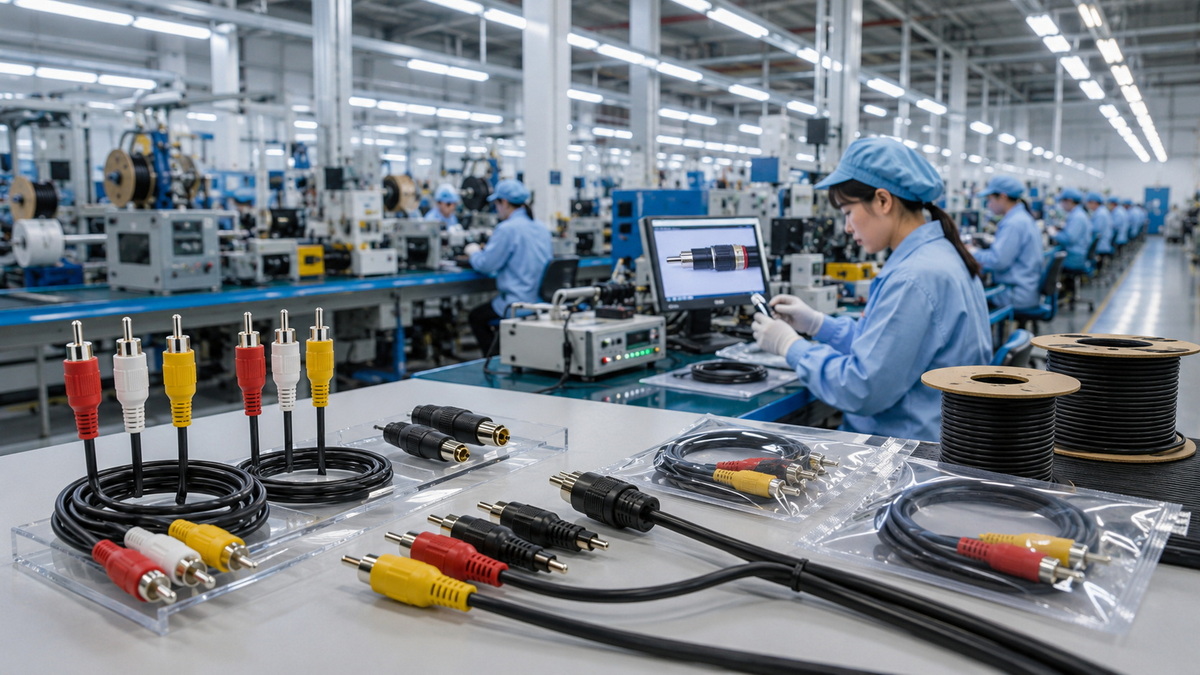
RCA audio and video cables may be considered legacy products, but they still play an important role in modern manufacturing, AV integration, and OEM supply. The best choice depends on the signal type, shielding quality, connector reliability, and the actual use environment.
For buyers, the goal is simple: choose a cable that matches the application, not just the connector. For brands and distributors, the opportunity is even bigger—use RCA cables as a customizable, dependable product category that supports both compatibility and margin.
Call to action: If you need OEM RCA audio cables, RCA video cables, or custom AV cable assemblies, request a sample and specify your target market, cable length, connector type, and packaging requirements.
RCA audio cables are used for analog sound signals, while RCA video cables are used for composite video. The connectors may look similar, but the cable application and performance requirements can differ.
Sometimes yes, but not always with the best results. Video signals are more sensitive to noise, so a cable designed for video is usually the safer choice.
No. Differences in conductor material, shielding, plating, jacket quality, and construction can affect performance and durability.
The best length is the shortest practical length for your installation. Longer cables can increase signal loss and interference risk.
OEM buyers often need custom length, custom color, branded packaging, and consistent quality for their market or product line.
1. [SEO for Manufacturers: Strategies to Dominate Search in 2025]
2. [SEO for Cable & Wire Suppliers | Reach More B2B Buyers | World SEO Agency]
3. [The complete guide to SEO for manufacturers - Sana Commerce]
4. [Manufacturer iCONN Systems Achieves Substantial Organic Growth Through SEO Campaign]
5. [SEO for Manufacturers: Why It Matters, Key Strategies, and an ...]


