


Views: 299 Author: Otechkabel Publish Time: 2026-06-28 Origin: Site


When selecting a PROFINET cable, the most important question is not just "Which type is cheaper?" but "Which cable type is right for the motion, vibration, and installation environment of my application?" PROFINET cable Type A, Type B, and Type C are designed for different mechanical conditions, and choosing the wrong one can lead to signal instability, premature wear, and unnecessary maintenance costs. [pcm-cable]
For engineers, system integrators, and industrial buyers, understanding these cable types is essential for building reliable Industrial Ethernet systems that perform consistently in real-world production environments. [engineeringservice]
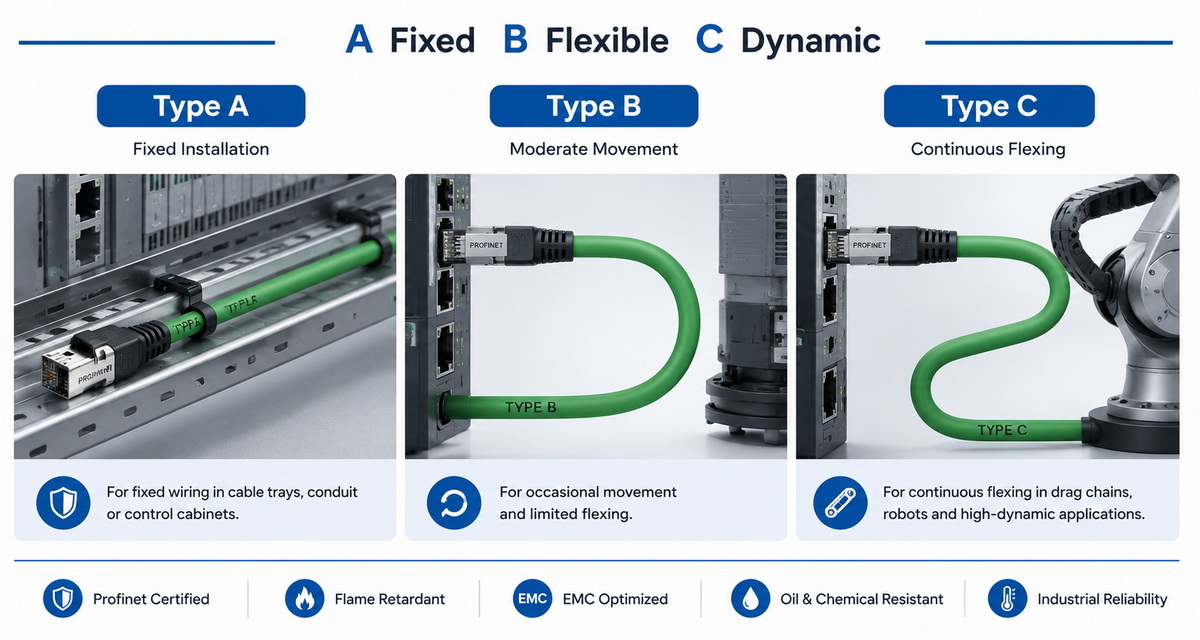
PROFINET cable types are defined to match different levels of installation stress, from fixed cabinet wiring to continuous motion in robotic systems. The main differences lie in conductor structure, flexibility, jacket material, and mechanical endurance. [us.profinet]
In simple terms:
- Type A is for fixed installation.
- Type B is for limited movement or vibration.
- Type C is for continuous flexing and dynamic use. [products.lappgroup]
| Feature | Type A | Type B | Type C |
|---|---|---|---|
| Installation | Fixed | Occasional movement | Continuous flexing |
| Conductor | Solid copper | Stranded copper | Fine-stranded copper |
| Flexibility | Low | Medium | High |
| Mechanical Strength | Standard | Enhanced | Maximum |
| Typical Jacket | PVC, FRNC, or TPU | PUR or TPU | TPU, TPE, or drag-chain-rated PUR |
| Common Use | Cabinets, trays, fixed links | Semi-mobile equipment | Robotics, cable chains, moving machines |
This table shows the core engineering logic behind the three PROFINET cable categories: the more movement the cable must survive, the more flexible and mechanically robust its construction becomes. [l-com]
PROFINET Type A cable is designed for stationary applications where the cable does not move during normal operation. It typically uses solid copper conductors, which provide stable electrical performance and are suitable for rigid routing inside control cabinets, cable trays, and wall-mounted systems. [pcm-cable]
This type is usually the most cost-effective choice because it is optimized for static environments rather than repeated bending. In practice, Type A is often used for PLC-to-switch connections, cabinet wiring, and other permanent installations where reliability matters more than flexibility. [pcm-cable]
Best for:
- Control cabinets.
- Fixed industrial Ethernet runs.
- PLC and switch interconnections.
- Wall-mounted or tray-based cable routing.
PROFINET Type B cable is built for applications that experience occasional movement, vibration, or moderate mechanical stress. Compared with Type A, it uses stranded conductors and more flexible jacketing, which improves resistance to bending and installation stress. [us.profinet]
This makes Type B a practical middle-ground option for many factory environments. It is often selected for sensor and actuator connections, machine tools with limited motion, and industrial systems where the cable must handle repeated handling or light movement without being fully dynamic. [us.profinet]
Best for:
- Semi-flexible machine wiring.
- Sensors and actuators.
- Equipment exposed to vibration.
- Short-distance motion with limited bending cycles.
PROFINET Type C cable is the most robust category for demanding motion applications. It is designed for continuous flexing, such as in drag chains, robotic arms, gantries, and automated equipment that bends the cable repeatedly throughout its service life. [l-com]
To withstand that environment, Type C uses extra-fine stranded conductors and highly durable jackets such as TPU, TPE, or drag-chain-rated PUR. The result is a cable designed to survive high bending cycles while maintaining stable transmission performance in dynamic installations. [l-com]
Best for:
- Robotic systems.
- Cable carriers and drag chains.
- Moving machine parts.
- High-cycle automation equipment.
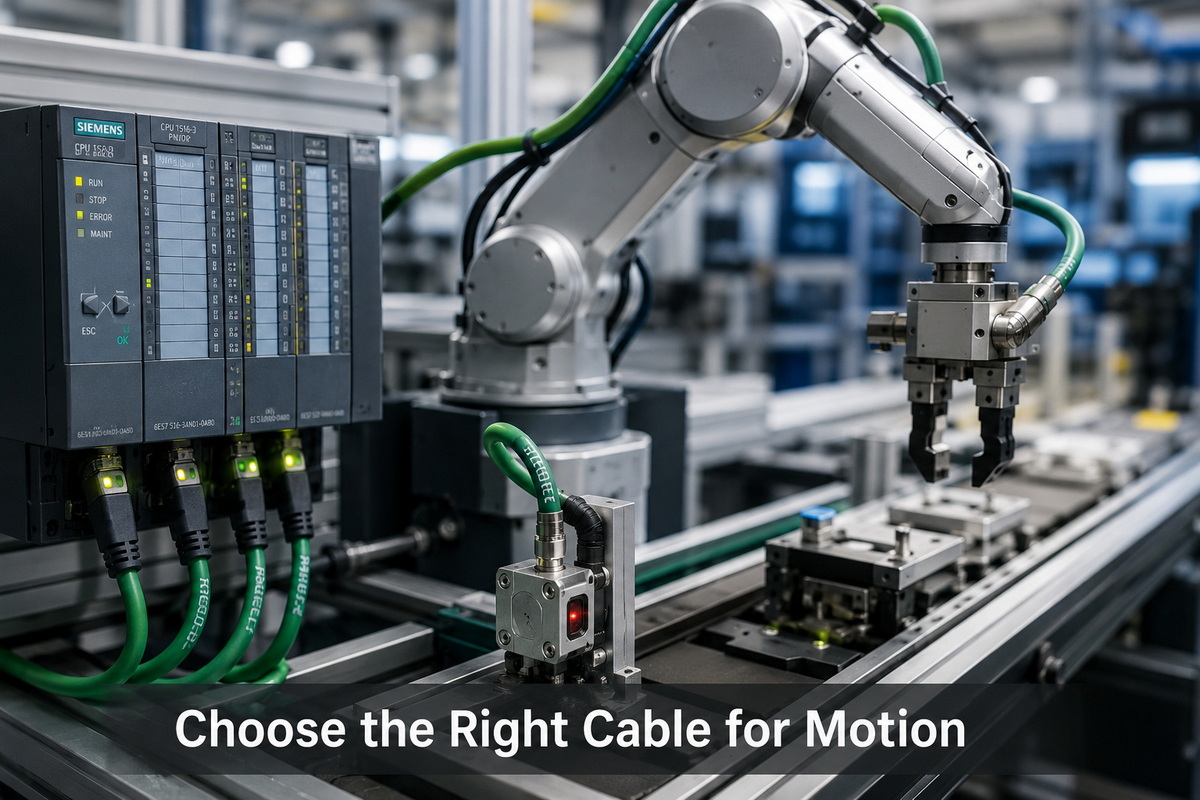
The right PROFINET cable choice depends on movement, vibration, temperature exposure, and installation method. If the cable remains fixed, Type A is usually enough. If the environment includes intermittent motion or vibration, Type B gives a better balance of cost and durability. If the cable moves continuously, Type C is the safer long-term choice. [products.lappgroup]
A practical selection checklist:
1. Identify whether the cable is fixed or moving.
2. Estimate how often it bends.
3. Check whether vibration is constant or occasional.
4. Confirm jacket material compatibility with oil, abrasion, or industrial chemicals.
5. Match the cable type to the machine life cycle, not just the installation budget.
Choosing a cable based only on price can create hidden costs later, including downtime, rework, and replacement labor. [engineeringservice]
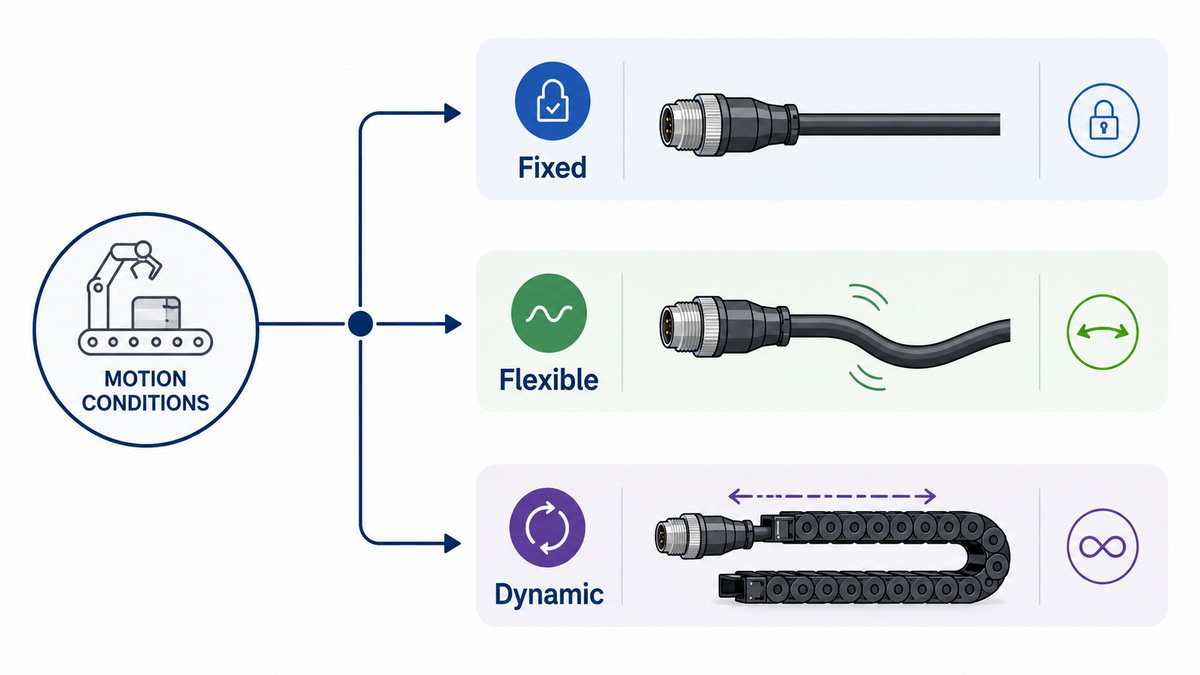
Cable type is not only about flexibility. The outer jacket also affects abrasion resistance, oil resistance, temperature performance, and long-term durability. PROFINET cable designs commonly use materials such as PVC, PUR, TPU, FRNC, and TPE depending on the installation environment. [products.lappgroup]
In industrial settings, the jacket often determines whether a cable survives real production conditions. For example, a drag-chain application with poor jacket selection may fail far earlier than expected, even if the conductors themselves are correctly specified. [l-com]
One common buying mistake is choosing the wrong cable category based on appearance rather than operating condition. A cable may look "heavy-duty," but if it is not designed for repeated motion, the internal conductor structure and jacket can still fail under stress. [pcm-cable]
From an OEM manufacturing perspective, buyers should request:
- The exact application scenario.
- Required bending cycles.
- Cable routing method.
- Environmental exposure conditions.
- Certification requirements such as CE, RoHS, FCC, REACH, UL, or customer-specific compliance needs. [cnotechkabel]
This reduces the risk of mismatched specifications and helps ensure the final cable performs as expected in the end user's system. [cnotechkabel]
For B2B buyers, cable selection is only one part of the equation. Supplier capability also matters, especially when the project requires stable quality, custom specifications, and repeatable production. Shenzhen Otechkabel Electronic Co., Ltd. positions itself as a professional cable manufacturer with years of experience in USB, VGA, HDMI, DVI, SATA, and related cable production, along with OEM/ODM support and strict process control. [cnotechkabel]
For international buyers, that means the supplier should be able to support:
- Custom cable structures.
- Stable mass production.
- Compliance documentation.
- Packaging and labeling customization.
- Long-term supply consistency. [otechkabel.en.alibaba]
A good cable choice can still underperform if installation is poor. To protect PROFINET performance and lifespan:
- Avoid tight bending beyond the cable's rated minimum bend radius.
- Separate signal cables from high-interference power lines.
- Use proper cable support in moving applications.
- Avoid twisting or stretching during installation.
- Inspect connectors and strain relief points during commissioning.
These steps help preserve signal integrity and reduce wear in both static and dynamic applications. [engineeringservice]
PROFINET Type A, Type B, and Type C cables are not interchangeable. Each one is engineered for a different mechanical environment, and the best choice depends on whether your application is fixed, moderately flexible, or continuously moving. [us.profinet]
For OEM buyers, distributors, and industrial integrators, the smartest approach is to match the cable structure to the real operating conditions, then confirm jacket material, certifications, and supplier capability before purchase. [cnotechkabel]
If you need custom PROFINET cables or want to source OEM/ODM cable solutions for industrial use, work with a manufacturer that can support material selection, stable production, and compliance-driven customization. Shenzhen Otechkabel Electronic Co., Ltd. can be positioned as a responsive manufacturing partner for global buyers. [cnotechkabel]
Type A is for fixed installations, Type B is for limited movement or vibration, and Type C is for continuous flexing and dynamic applications. [pcm-cable]
It is not recommended for moving machinery because Type A is designed for static environments and may wear out faster under repeated bending. [pcm-cable]
No. Type C is excellent for motion-heavy applications, but it may be unnecessary and more expensive for fixed wiring. [products.lappgroup]
Type C is the preferred choice because it is designed for continuous flexing and high mechanical endurance. [l-com]
The jacket affects abrasion resistance, oil resistance, flexibility, and durability, which are critical in industrial environments. [products.lappgroup]
1. Shenzhen Otechkabel Electronic Co., Ltd. – About Us: [https://www.cnotechkabel.com/about-us] [cnotechkabel]
2. PCM Cable – Profinet Cable: Type A vs B vs C Explained: [https://www.pcm-cable.com/info/profinet-cable-type-a-vs-b-vs-c-103050474.html] [pcm-cable]
3. LAPP Group – Industrial communication with PROFINET: [https://products.lappgroup.com/technologies-profinet.html] [products.lappgroup]
4. PROFINET official site – Cables: requirements, specifications, and types: [https://us.profinet.com/profinet-cables-requirements-specifications-and-types/] [us.profinet]
5. L-com – Types of PROFINET Cables (A, B, C, D) Explained: [https://www.l-com.com/resources/blog/technical-fundamentals-types-of-profinet-cables] [l-com]
6. Engineering Service – PROFINET Network Design Best Practices: [https://engineeringservice.net/knowledge/profinet-network-design-best-practices] [engineeringservice]


